
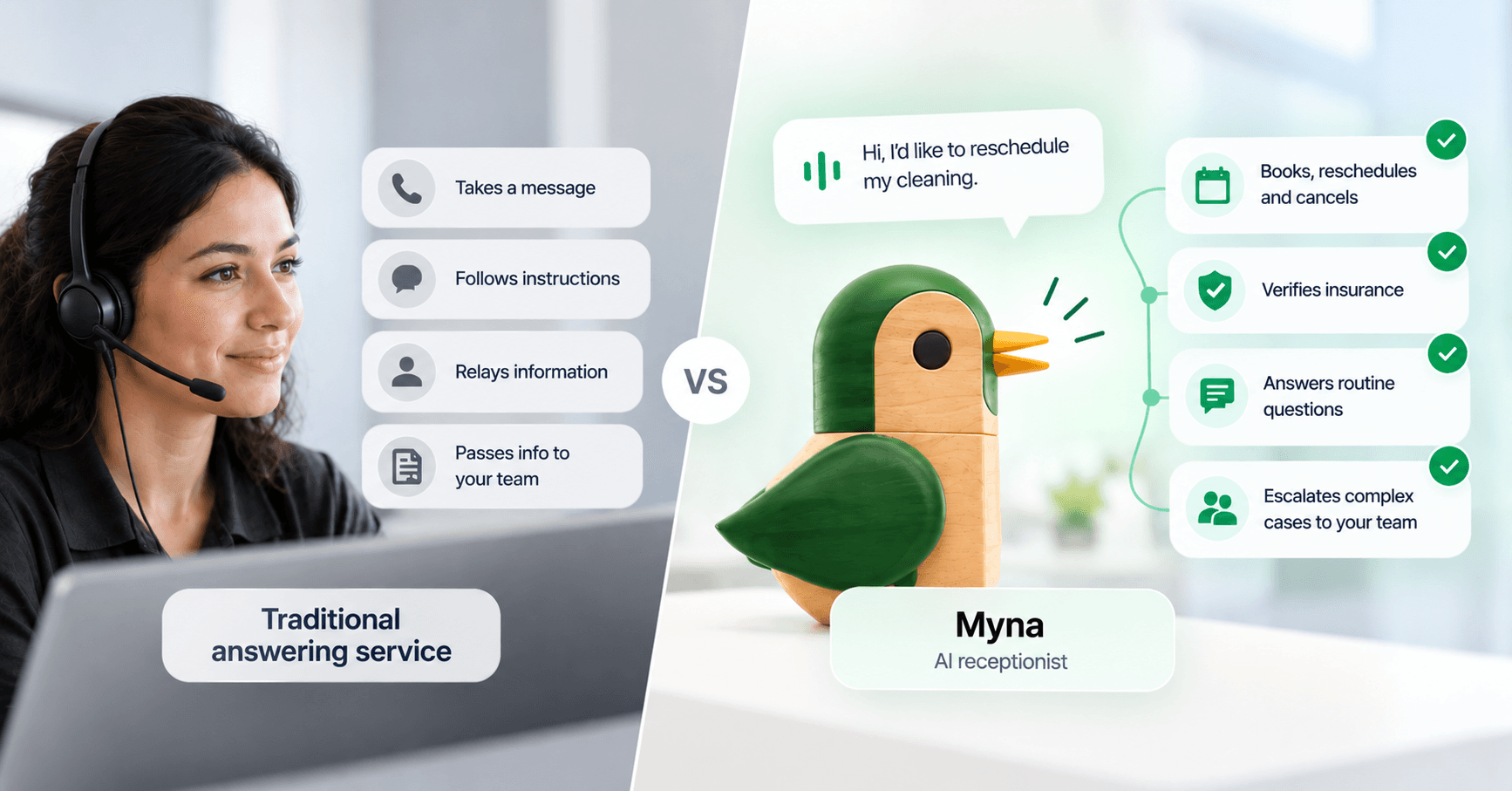
An answering service handles incoming calls and passes information to your team. An AI receptionist can go further by handling conversations and completing defined front-office tasks.
That distinction matters as healthcare organizations put more AI into practice operations. A September 2025 Medical Group Management Association (MGMA) poll found that 68% of medical groups had added or expanded AI use that year, with scheduling and patient communications among the common use cases.
But not every AI receptionist does the same work. Some mainly replace phone answering. Others can book appointments, update systems, and handle more of the workflow.
Keep reading to see what separates an answering service from an AI receptionist and where Myna fits in.
What is the difference between an AI receptionist and an answering service?
An answering service provides human call coverage. An AI receptionist interacts with patients and can handle defined tasks. The key difference is what happens after the call is answered.
An answering service typically takes messages or follows predefined instructions. An AI receptionist can understand the request and, when integrated with your systems, take action.
An answering service typically adds people to your existing phone workflow. They answer calls per your instructions and relay information back to your team.
An AI receptionist adds a digital layer to that workflow. It can understand what a patient is asking, respond in real time, and handle supported requests without waiting for staff intervention.
What does an AI receptionist add beyond an answering service?
An AI receptionist can hold a conversation, answer routine questions, and complete defined tasks such as booking, rescheduling, or canceling appointments. More capable systems can connect those actions to existing scheduling or practice systems.
That creates an important difference from traditional answering services.
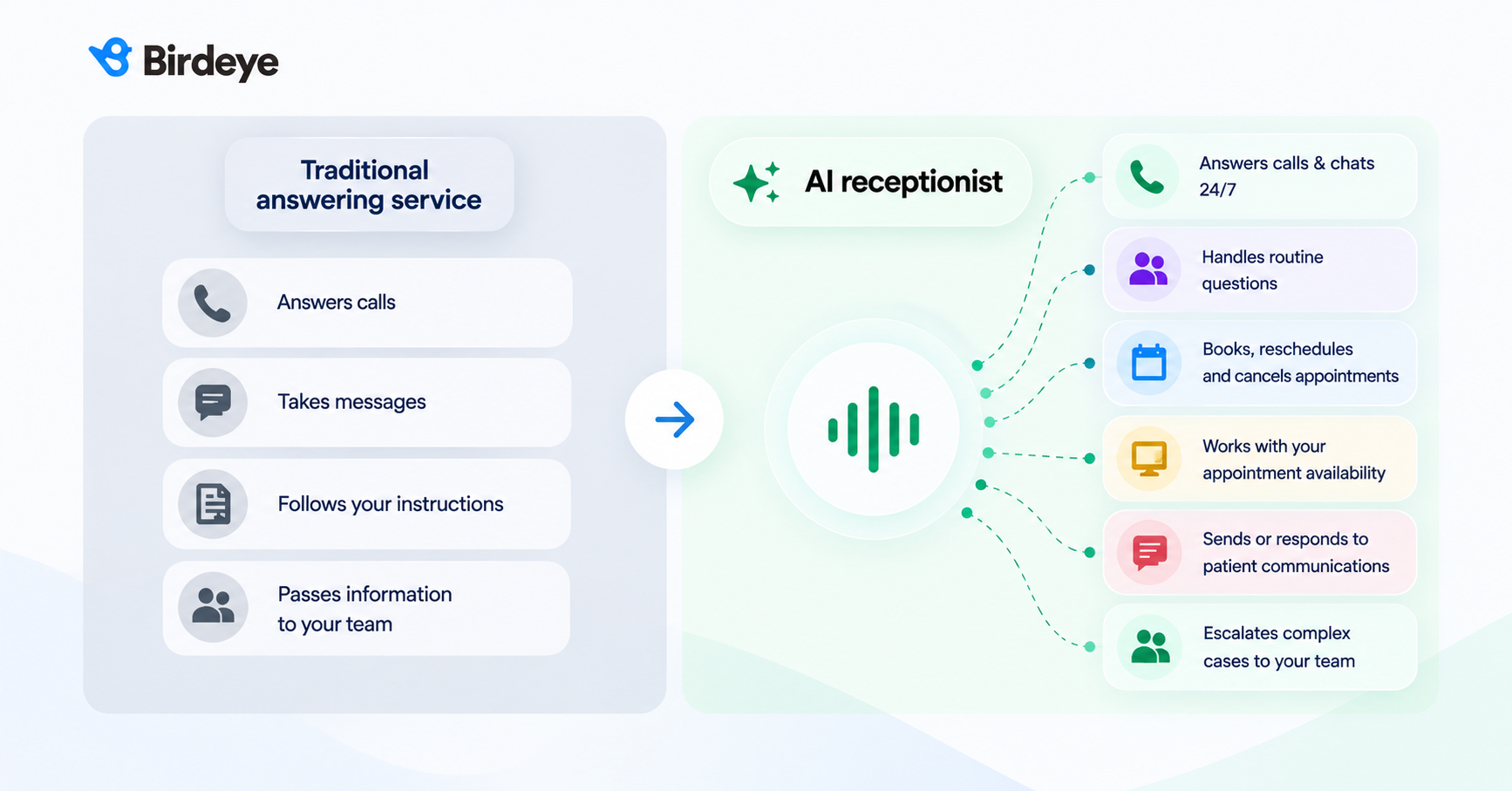
But an AI receptionist is a category, not a guarantee of all these capabilities.
Before choosing one, buyers should ask what the system can actually execute. Can it update the EHR or PMS? Can it work with live appointment availability? Does a completed conversation create a completed action or another task for staff?
That is where the comparison becomes more useful than simply asking whether the system uses AI.
Is an AI receptionist worth it for healthcare and dental organizations?
An AI receptionist is worth considering when it removes meaningful front-office work rather than simply answering more calls. The value comes from completed actions, recovered staff capacity, and fewer manual follow-ups.
For healthcare and dental organizations, look at five practical questions:
- Can it complete the task?
Booking an appointment is more useful than taking a message about an appointment. - Can it work with existing systems?
Staff should not have to copy information from another platform into the EHR or PMS. - Can it handle routine conversations?
Patients should be able to get appropriate answers from an AI chatbot for healthcare without creating another task for staff. - Can it hand off appropriately?
With an AI human-in-the-loop approach, staff should receive cases that require judgment instead of reviewing every routine interaction. - Can it support multiple locations?
Enterprise organizations need consistent workflows without making every location manage automation differently.
The ROI question is therefore bigger than call volume.
How much front-office work does the system actually complete?
Is there a free AI answering service or virtual answering service?
Free AI answering services and virtual receptionist call answering may offer basic call handling or limited usage. More advanced capabilities, such as system integrations and appointment execution, may require a paid solution.
That makes price only one part of the comparison.
A low-cost service may answer every call but still leave your staff responsible for scheduling, follow-up, and other actions. A more capable system can take more of that work off its queue.
For healthcare and dental organizations, compare completed work, not just the cost of answering a call.
How does Myna compare with a traditional answering service?
Myna, Birdeye's Operations AI Coworker, goes beyond the traditional AI receptionist model by coordinating specialized agents around shared patient context. The agents handle connected front-office workflows rather than stopping when the conversation ends.
The workflows differ by organization.
For healthcare organizations, that can connect front-desk conversations with scheduling, insurance verification, intake, reminders, and waitlist workflows.
For dental organizations, it can connect scheduling with reminders, waitlist management, recall, treatment plans, and revenue follow-up, supporting broader dental patient retention strategies.
Staff still handle situations that require judgment. Myna handles recurring workflows that can follow defined processes.
For healthcare organizations
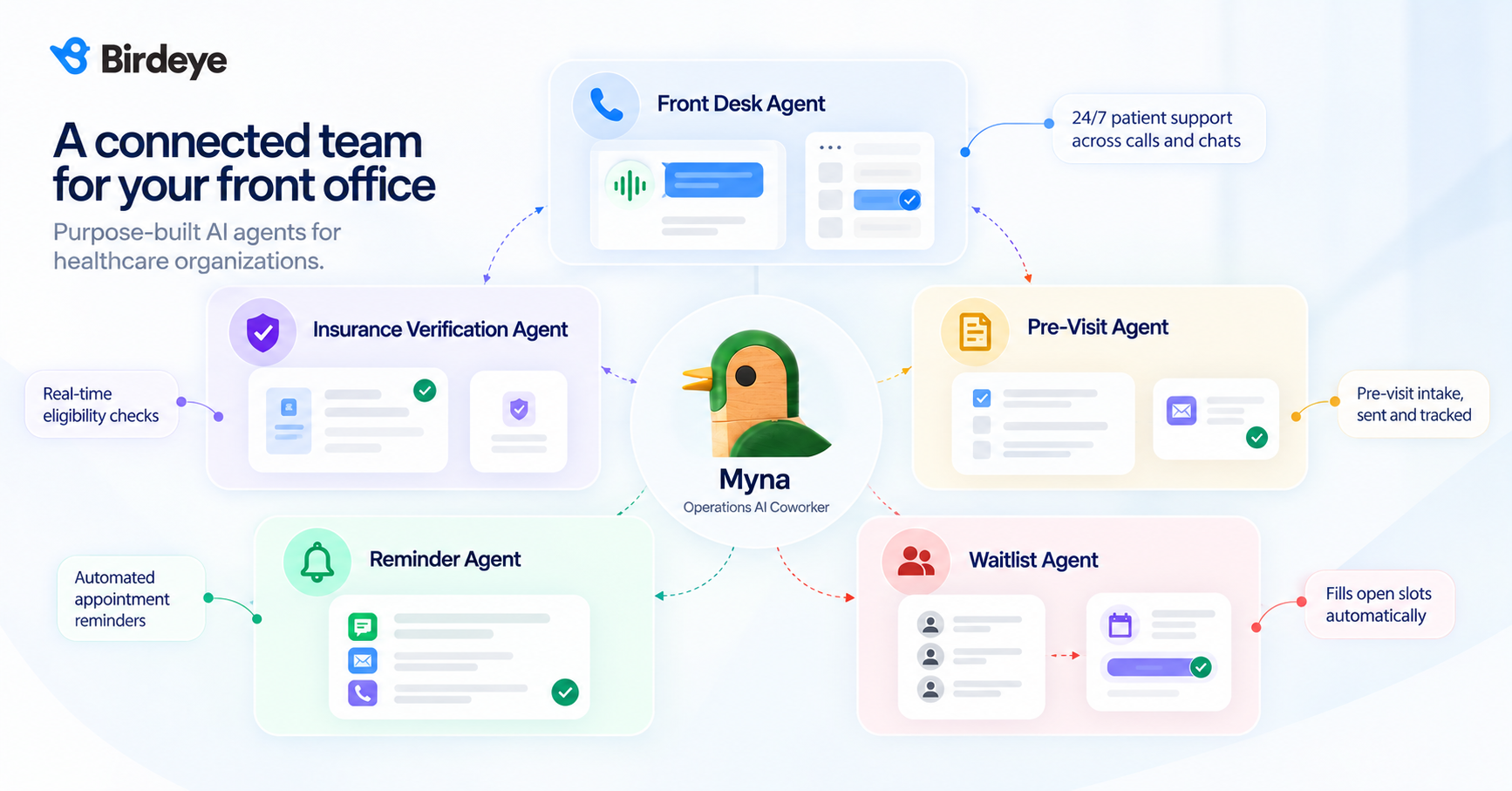
| Agent | What it does | The work it does |
| Front Desk Agent | Books appointments | Answers every call and chat, 24/7. Books, reschedules, and cancels in your EHR. |
| Insurance Verification Agent | Completes verifications | Verifies eligibility in real time and attaches the policy to the appointment. |
| Pre-Visit Agent | Completes intakes | Sends intake before the visit and follows up until it's done. |
| Reminder Agent | Prevents no-shows | Confirms by text, email, and voice. Chases no-shows before you lose the slot. |
| Waitlist Agent | Fills slots | Matches an open slot to a waiting patient the moment a cancellation hits. |
For dental organizations
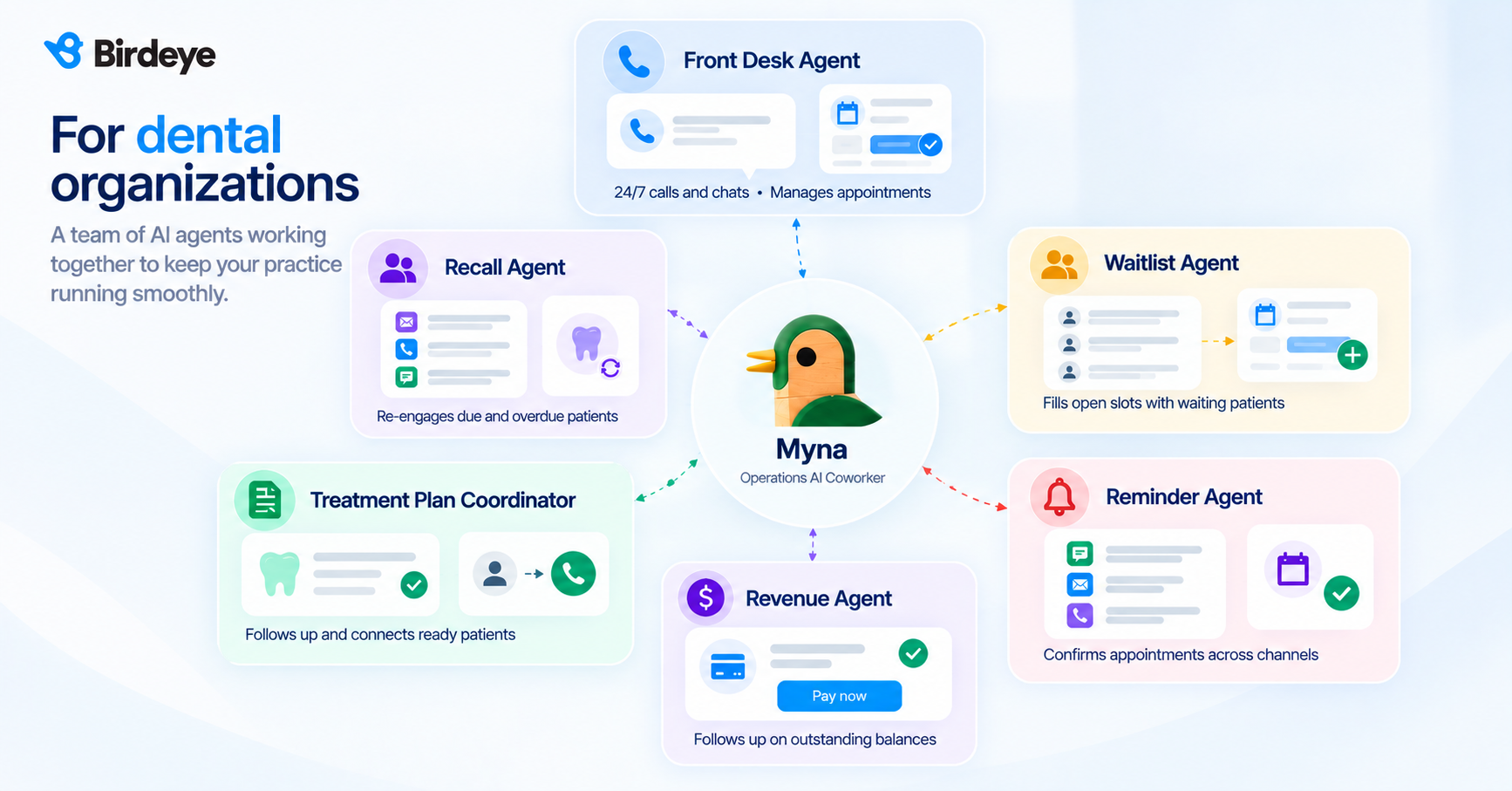
| Agent | What it does | The work it does |
| <a href="https://myna.ai/front-desk-agent">Front Desk Agent</a> | Books appointments | Answers every call and chat, 24/7. Books, reschedules, and cancels in your EHR. |
| <a href="https://myna.ai/reminder-agent">Reminder Agent</a> | Prevents no-shows | Confirms by text, email, and voice. Chases no-shows before you lose the slot. |
| <a href="https://myna.ai/waitlist-agent">Waitlist Agent</a> | Fills slots | Matches an open slot to a waiting patient the moment a cancellation hits. |
| <a href="https://myna.ai/recall-agent">Recall Agent</a> | Reactivates patients | Re-engages patients who are due, overdue, or dormant, by text, voice, and email. |
| <a href="https://myna.ai/treatment-plan-coordinator-agent">Treatment Plan Coordinator</a> | Accepts plans | Follows up on unaccepted plans and warm-transfers ready patients to your team. |
| <a href="https://myna.ai/revenue-agent">Revenue Agent</a> | Collects balances | Chases outstanding balances with secure payment links. HIPAA and PCI compliant. |
The important difference is how these agents work together. Unlike a loose multi-agent setup, Myna brings these agents together as one coworker, with shared patient context between them.
How should healthcare and dental organizations choose between an AI receptionist and an answering service?
The right choice depends on how much front-office work you need handled after the phone is answered. An answering service mainly provides coverage. An AI receptionist can handle conversations and defined tasks. For larger healthcare and dental organizations, integration, workflow execution, and multi-location consistency become equally important when comparing patient engagement tools.
| What you need | Answering service | AI receptionist |
| Answer calls after hours | Yes | Yes |
| Handle routine patient questions | Limited | Yes |
| Book appointments | Sometimes | Yes, depending on integration |
| Reschedule or cancel appointments | Limited | Yes, depending on integration |
| Work with EHR/PMS systems | Usually limited | Depends on the platform |
| Handle multiple front-office workflows | Limited | Varies by solution |
| Support multi-location operations | Depends on provider | Depends on platform and integrations |
| Coordinate work across specialized agents | No | Varies by platform |
For a DSO or healthcare organization, that last distinction can change the buying decision. You are not only choosing who answers the phone. You are choosing how much work happens after the interaction begins.
Myna takes that work further by coordinating specialized agents across healthcare and dental front-office workflows.
FAQs
Myna can automate more of your front office operations
The difference between an answering service and an AI receptionist goes beyond who answers the phone. It comes down to how much of the resulting work can be handled without adding another task for staff.
For healthcare and dental organizations, that distinction becomes more important as patient volume and operational complexity grow. Myna, Birdeye's Operations AI Coworker, extends that work across coordinated front-office workflows, while staff stay in control of decisions that require human judgment.
See how Myna can automate more of your front office.
About the Author
Shruti Dugar is a Senior Content Marketing Writer with 11+ years of experience in content and storytelling. At Birdeye, she writes about how AI coworkers help multi-location brands win AI visibility and deliver seamless customer experiences. She’s also a published author & enjoys traveling. Connect with Shruti Dugar on LinkedIn.