
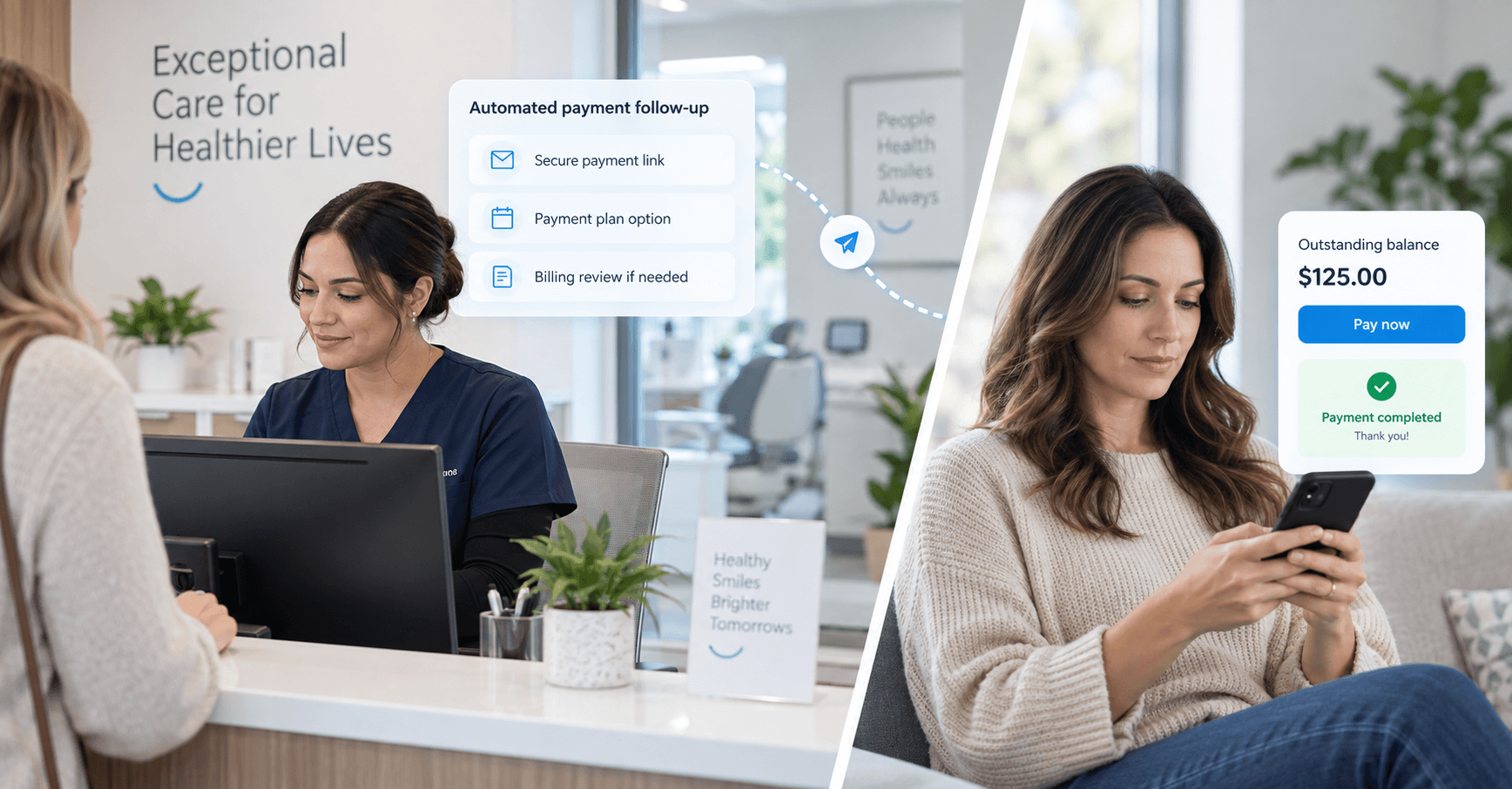
DSOs can collect more outstanding patient balances by standardizing follow-up and automating routine outreach across every location. Instead of relying on staff to remember when to call, text, or send reminders, automated workflows keep collections moving on schedule. Staff only step in when a patient needs help or a judgment call.
Summary
Outstanding balances grow when payment follow-up depends on busy front-desk teams and varies by location. Standardized, automated outreach keeps collections moving before balances age further. Myna, Birdeye’s Operations AI Coworker, employs a Revenue Agent to follow up on outstanding balances, send secure payment links, offer payment plans, schedule follow-ups, and route disputes to the billing team. That helps resolve balances without staff making awkward collections calls.
Why do outstanding patient balances go uncollected across DSOs?
Outstanding balances often age because payment follow-up depends on busy staff, inconsistent processes, and uncomfortable conversations. KFF reported in 2026 that 24% of U.S. adults had medical or dental bills that were past due or that they couldn't pay.
For DSOs, that creates an even stronger need for timely, structured follow-up. While patients may have different reasons for delaying payment, balances often remain unresolved longer because the collection process itself breaks down.
Common DSO-side reasons payment follow-up falls short include:
- Front-desk priorities take over: Staff are handling patients, calls, scheduling, insurance questions, cancellations, and emergencies, so collections slip down the list.
- Payment conversations feel awkward: Asking a patient for overdue money can be uncomfortable, especially for staff who also manage that patient’s ongoing care experience.
- Follow-up varies by location: One office may text within a few days, another may wait for the next statement, and another may not follow up until the patient returns.
- There is no consistent next step: If the first reminder gets no response from the patient, the account may sit until someone notices it again.
Consider a patient with a $180 balance after insurance processes a claim. The office misses the first reminder because it is short-staffed. Two weeks later, someone plans to call but gets pulled into other work. At 30 days, the patient receives a statement but no direct follow-up. By 60 days, the balance is competing with newer accounts. At 90 days, the patient will have questions about what insurance covered, turning what could have been a simple reminder into a more complicated billing conversation.
That is why timing matters. The American Dental Association recommends evaluating whether 90% of fees due are paid within 30 days and the remaining 10% within 60 days. If they are not, the ADA recommends reviewing the dental practice’s collection systems and procedures.
The ADA also notes that payments more than 90 days in arrears will most likely never be collected, reinforcing the need for timely, consistent follow-up before balances age further.
How do inconsistent collections become a network-wide revenue problem for DSOs?
At one dental office, a missed payment reminder may seem minor. Across 100 locations, those small gaps can quickly become a much larger accounts receivable problem. MGMA reported that 29% of medical group leaders said patient balance collections had worsened compared with the previous year.
A simple way to think about this is:
Outstanding patient balances × percentage missing scheduled follow-up = balances at risk of aging unnecessarily
Consider a DSO with 100 locations, each carrying an average of $20,000 in outstanding patient balances. That adds up to:
100 locations × $20,000 = $2 million in patient accounts receivable
If just 10% of those balances are not receiving follow-up on schedule:
$2 million × 10% = $200,000 in balances receiving inconsistent follow-up
That does not mean the DSO will lose $200,000. It means a significant portion of its receivables is aging without a consistent collection process. This is not just a collections issue. It can become a broader revenue-cycle leak. In January 2026, MGMA found that 14% of medical groups identified billing and collections as their biggest source of revenue-cycle leakage, with outdated collection methods and weak post-insurance follow-through among the problems organizations were addressing.
The problem compounds as new balances arrive each month. If older accounts keep moving into the 31-to-60-day and 61-to-90-day buckets, staff spend more time chasing aging revenue instead of preventing balances from getting there in the first place.
Why doesn't "train staff better" fix patient balance collections?
Scripts and retraining can help, but they do not solve the core problem. Follow-up still depends on staff remembering to act. Automation removes that dependency by sending reminders and payment links on schedule, without adding another task or awkward conversation to the front desk.
How can DSOs standardize payment follow-up across every location?
A standardized workflow defines what happens when a balance becomes due, what happens if the patient doesn't respond, when to use another channel, and when staff needs to step in.
The goal should not be to make every front desk better at remembering collections. The goal should be to remove the need to remember from the process.
| <strong>Stage</strong> | <strong>Standardized action</strong> | <strong>Why it matters</strong> |
|---|---|---|
| Balance becomes due | Trigger the first approved payment communication | Follow-up starts on time |
| No response | Send the next reminder after the defined interval | Accounts do not disappear after one attempt |
| Balance remains open | Continue the approved cadence across available channels | Every location follows the same process |
| Patient responds | Answer routine questions or capture the patient’s status | Patients have a clear path forward |
| Exception identified | Escalate disputes, insurance issues, hardship cases, or other exceptions | Staff focus on conversations requiring judgment |
| Payment resolved | Stop follow-up and update the patient record | Prevents unnecessary outreach |
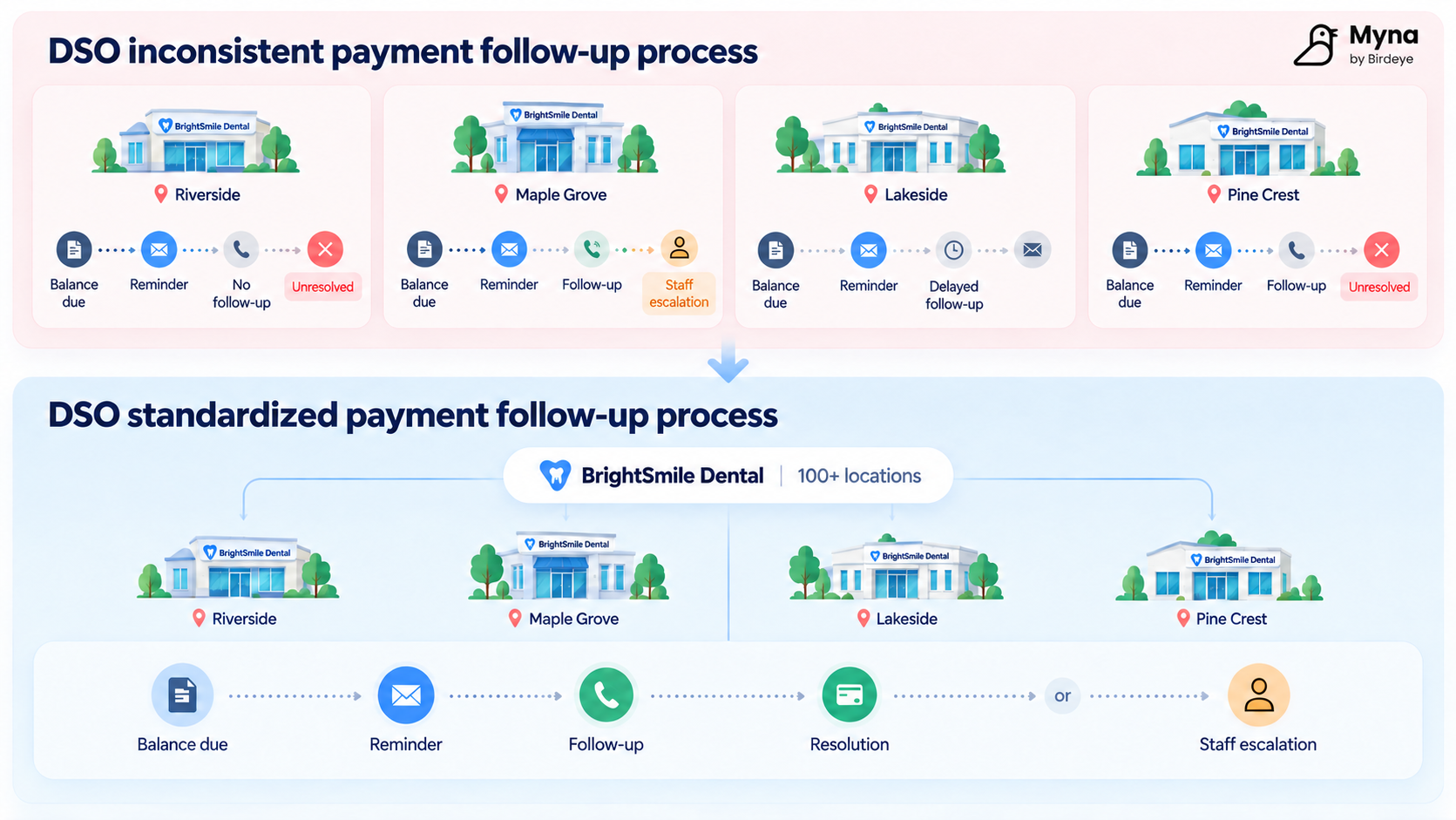
Standardization does not mean bombarding patients with messages. It means every balance moves through a defined follow-up process, using AI and automation, regardless of which location owns the account.
How does Myna help DSOs automate outstanding balance follow-up?
Myna , Birdeye’s Operations AI Coworker, employs a Revenue Agent that follows up on patient outstanding balances so staff don't have to initiate every collections conversation manually.
The Revenue Agent works the DSO’s outstanding balances across locations, keeping follow-up moving even when the front desk is busy. It can:
- Send secure payment links: Give patients a simple way to resolve an outstanding balance without calling the office.
- Offer payment plans: Provide another path to payment when a balance cannot be cleared at once.
- Schedule follow-up: Continue outreach when a patient does not resolve the balance after the first attempt.
- Route disputes to the billing team: Escalate situations that require human review instead of trying to resolve them automatically.
The result is straightforward: the patient payment balance will clear without a collections call from staff, while disputes and exceptions still reach the people equipped to handle them.
Myna’s Revenue Agent is HIPAA- and PCI-compliant and works as part of the same Operations AI Coworker that supports other dental front-office workflows, including recall, treatment plan follow-up, scheduling, waitlist management, and reminders.
For DSOs, this creates a more scalable collections model. Routine payment follow-up happens automatically across locations, while staff stays focused on patients and the billing conversations that genuinely require human judgment.
How can DSOs put every outstanding balance on a clear path to resolution?
For DSOs, stronger collections start with making sure no balance is left waiting for someone to notice it. A defined workflow gives every account a next step, whether that is a payment link, another follow-up, a payment plan, or escalation to the billing team.
This shift is already underway across dentistry. According to the ADA Health Policy Institute, around two in five dentists already use AI for at least one task such as front-desk, appointment scheduling or billing while another quarter plan to use it in the future.
For DSOs, that creates an opportunity to use AI and automation where it can have a direct operational impact, including reducing aging receivables, protecting staff capacity, and keeping payment follow-up moving across every location.
Explore how Myna can automate payment follow-up for your DSO.
FAQs
About the Author
Somya is a Content Editor at Birdeye with 9+ years of experience in content management, primarily supporting B2B SaaS brands. She brings a strong command of content strategy, SEO, GEO, and editorial planning, along with a sharp eye for crafting narratives that engage and convert. Over the years, Somya has helped scale content operations, optimize digital presence, and drive organic growth & AI visibility for fast-paced tech companies. When she’s not writing or immersed in editorial calendars, you can find her playing with her dog, Kaizer. Connect with Somya Yesodharan on LinkedIn.