
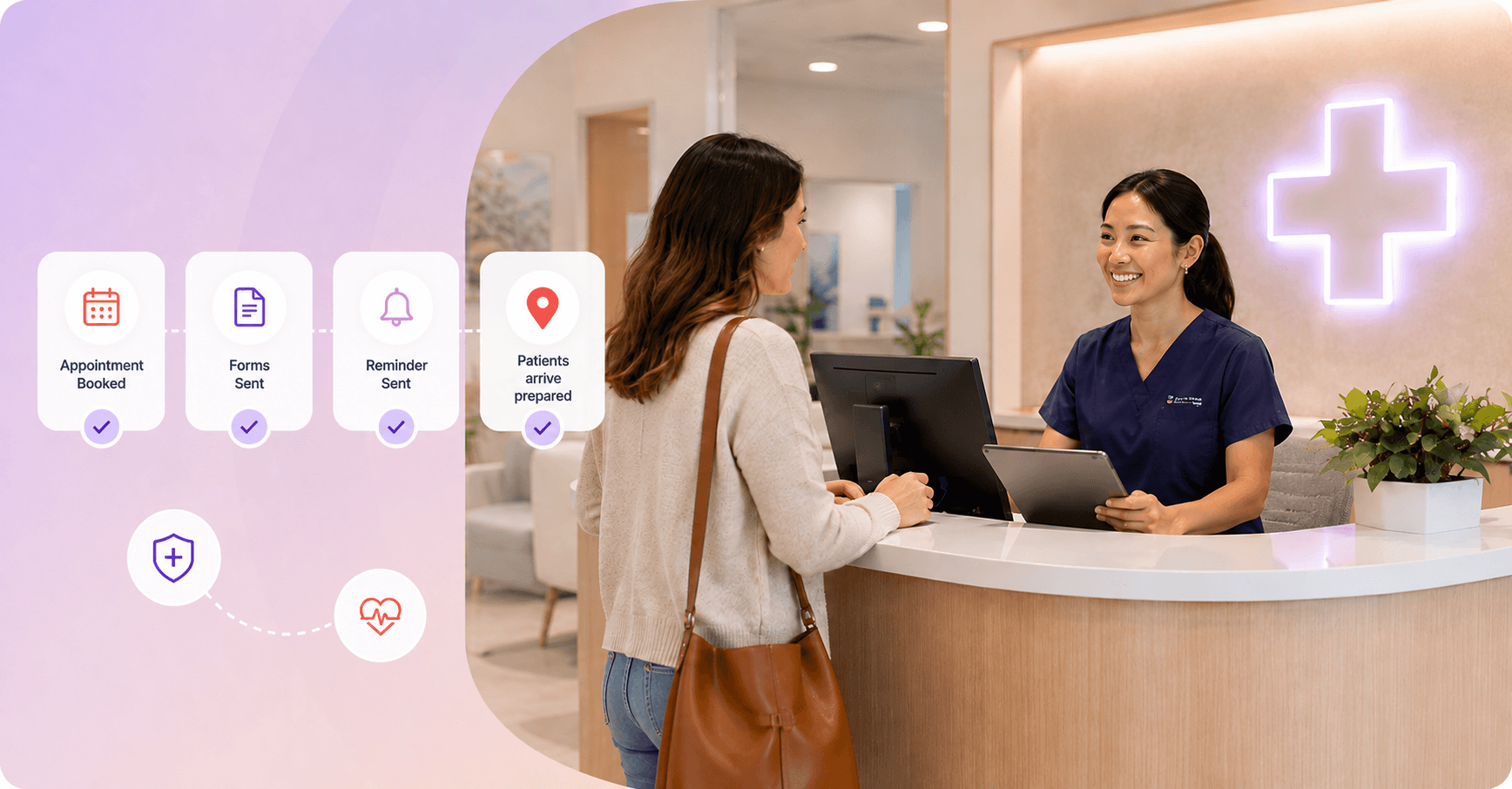
Health systems can prevent patients from arriving unprepared by automating pre-visit intake communication as soon as an appointment is booked. Forms, intake requests, and preparation instructions should reach patients before the visit without requiring staff to remember each step. When outreach happens proactively, patients arrive ready, front desks spend less time chasing paperwork, and appointments start on schedule.
Summary
Incomplete pre-visit patient intake paperwork is often a workflow problem. Manual handoffs, disconnected systems, inconsistent processes, and missed reminders can leave patients without the information they need before an appointment. With Myna, Birdeye’s AI coworker for operations, health systems can automate front-office workflows such as patient communication, appointment coordination, and reminders to ensure patients walk in 100% prepared.
How can one missing intake form put the rest of the day behind?
A 2025 Pain Management study found that 82.4% of patients who completed questionnaires at home considered the process time-efficient, compared with just 28% who completed them at the clinic.
The problem is not just paperwork. It is clinical time being consumed by administrative work that could have happened before the patient walked through the door.
Picture a standard Tuesday morning at a busy health system clinic.
A patient arrives at 9:55 a.m. for a 10 a.m. appointment. At check-in, the front desk discovers that the patient never received the new-patient intake packet.
The patient is now handed a clipboard stacked with four double-sided paper forms:
- Medical history
- HIPAA consent
- Insurance verification
- Symptoms questionnaire
The patient sits down, searches for a pen, and spends 15 minutes filling out information that could have been handled before arrival.
By the time the clipboard is handed back, it is already 10:15. The front-desk coordinator now needs to review the information, verify the insurance card, scan the paperwork, and enter relevant details into the electronic health record (EHR).
The clinical team is ready, but the intake process is still catching up.
The appointment begins late. The physician enters the examination room nearly 20 minutes behind schedule. Repeat this pattern several times in a day, and a missed pre-visit patient intake step can turn into longer waits, more pressure on staff, and a schedule that stays behind for the rest of the day.
Why do patients still arrive without completed forms?
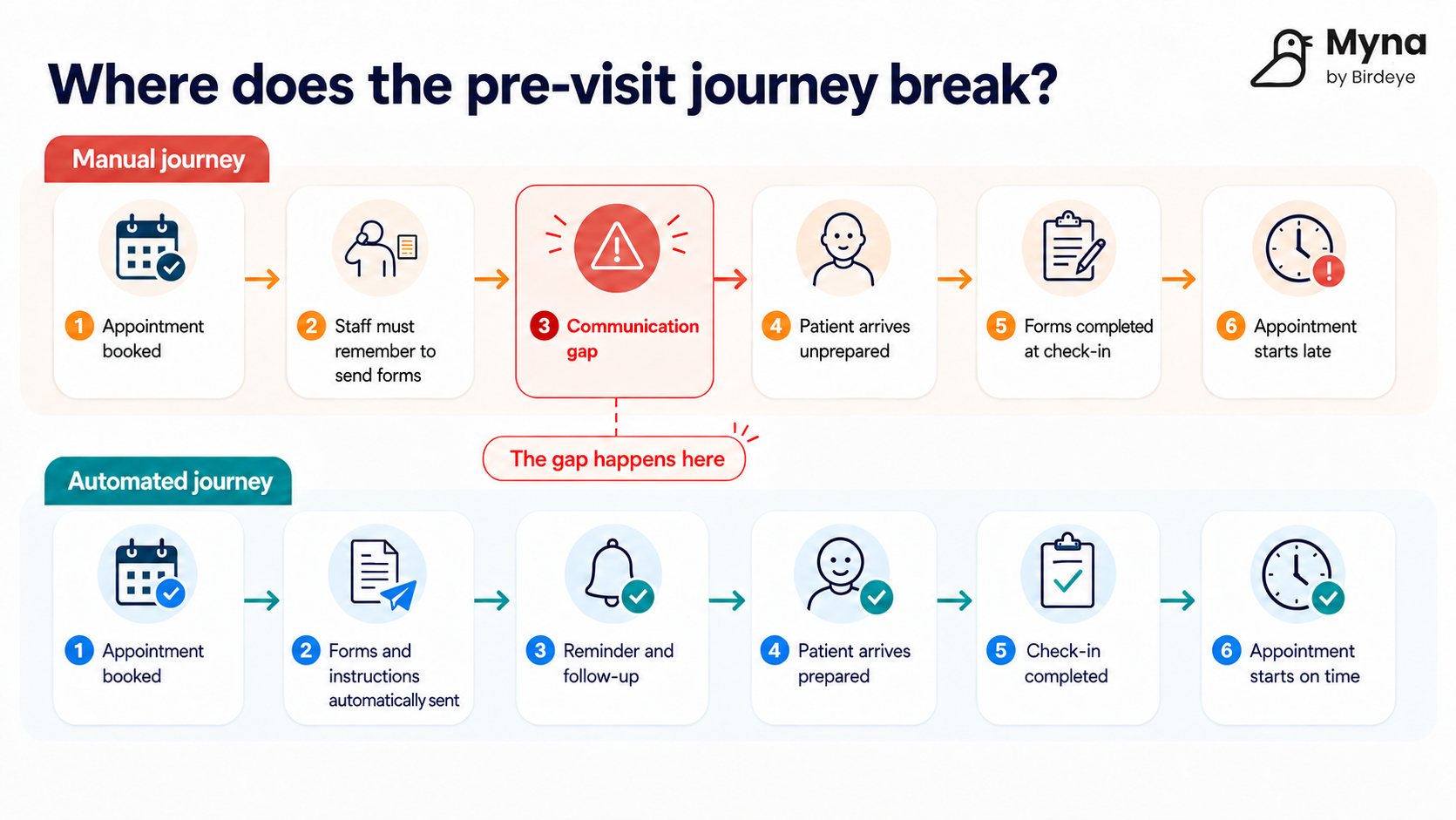
In many health systems, pre-visit patient intake preparation depends on a chain of manual actions. Someone books the appointment. Someone else needs to send the intake packet. Another team may need to provide procedure-specific instructions. Staff may also need to follow up if the patient never completes the paperwork.
Multiply that workflow across hundreds of appointments, specialties, and locations, and small gaps become routine.
Common breakdowns include:
- Staff manually trigger outreach: Sending the form becomes another item on an already crowded task list.
- Scheduling and communication systems don't work together: Booking an appointment doesn't automatically start the appropriate patient journey.
- Different locations follow different processes: One clinic sends forms immediately while another waits until the day before the visit.
- Patients receive one message with no follow-up: An email sent seven days ago can easily get buried under everything else in an inbox.
- Instructions arrive too late: Patients may need time to complete medical histories, gather documents, confirm medications, arrange transportation, or follow preparation requirements.
The weak point is often not the form itself. It is the handoff.
What does incomplete patient intake cost a multi-location health system?
When incomplete pre-visit patient intake happens occasionally, staff can usually absorb it. When it happens every day across a health system, it becomes an operational problem.
Front-office teams are already balancing several labor-intensive workflows. In a 2026 MGMA poll, practice leaders identified eligibility and prior authorization (45%), scheduling (31%), and intake (9%) as the phone tasks consuming the most staff time.
When incomplete paperwork creates another round of questions, verification, and follow-up at check-in, it adds work to teams that are already managing competing patient-access demands.
The effects spread quickly:
- Front-desk workload increases: Staff must print forms, explain requirements, locate missing information, resend links, and troubleshoot issues that could have been handled before arrival.
- Clinical schedules become less predictable: A delayed first appointment can create a domino effect across subsequent visits.
- Patients spend more time waiting: Someone who arrived on time may still feel that the organization is running late.
- Staff experience more avoidable pressure: Front-office and clinical teams spend time recovering from preventable workflow gaps instead of focusing on higher-value patient needs.
A JAMA Internal Medicine study found that 47.9% of physicians worked with an incompletely staffed team more than 25% of the time. Among those physicians, 61.1% reported burnout, compared with 35.8% among those who worked with incomplete teams less often.
- The experience varies by location: One clinic may have a strong pre-visit routine while another relies heavily on individual staff habits.
How can health systems build pre-visit workflows around triggers instead of memory?
Pre-visit patient intake preparation works best when patients receive the right information before they arrive. A study published in Palliative Medicine by researchers affiliated with Dartmouth Health found that 79% of surveyed patients said an electronic pre-visit questionnaire has helped their conversations with clinicians.
A better model starts with the appointment itself. Once an appointment enters the health system’s scheduling workflow, that event should trigger the next required actions automatically.
Here’s how to build that trigger-based workflow step by step:
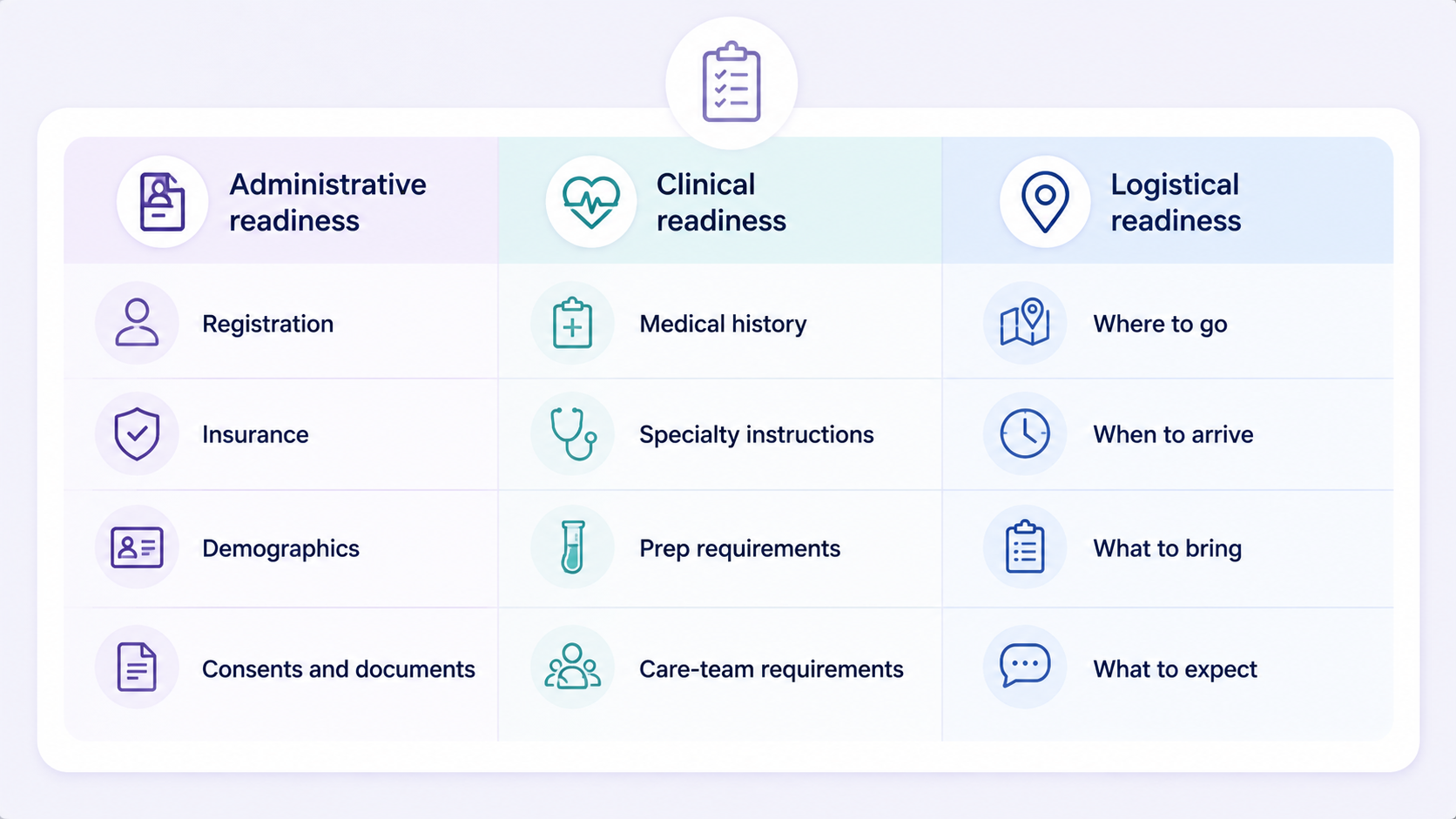
- Define what “fully prepared” means: Establish the administrative, clinical, and logistical requirements patients should complete before arrival.
- Appointment booked: Identify the location, appointment type, and required pre-visit steps.
- Forms and instructions sent: Deliver the appropriate intake links and preparation information through an approved communication channel.
- Patient reminded: Follow up before the appointment instead of assuming the first message was seen.
- Questions handled: Give patients an easy way to respond when they need clarification.
- Patient arrives prepared: Staff spend check-in confirming information rather than starting the intake process from scratch.
The goal is not simply to automate more messages. It is to make sure each patient arrives administratively, clinically, and logistically ready for their appointment.
Automation does not remove people from the patient experience. It removes the repetitive coordination work that makes it harder for healthcare employees to deliver a good experience.
How does Myna solve the intake gap for multi-location healthcare organizations?
Myna is Birdeye’s AI coworker for operations that employs specialized agents to run front-office workflows across locations. Instead of relying on staff to remember every form, reminder, and follow-up, Myna helps health systems make pre-visit patient intake communication part of an automated patient journey. Its specialized agents include Care Coordination, Appointments, Reminders, and Front Desk agents.
Myna can support the process by helping health systems:
Coordinate appointment communication
Myna monitors your scheduling queue in real time. The moment an appointment is booked, rescheduled, or updated in your EHR, Myna automatically initiates the appropriate pre-visit workflow via SMS and email based on specialty, provider, and visit type.
Automate patient reminders
Myna’s Reminders Agent helps keep upcoming actions from falling through the cracks by supporting appointment reminders and proactive patient outreach across digital channels. This gives health systems a more consistent way to keep patients informed instead of depending on a single message being opened and acted on.
Collect intake information digitally
Myna writes discrete data directly into the appropriate fields in your EHR. Insurance cards, demographic updates, medical histories, and consent signatures are filed instantly, making the patient instantly ready for clinical intake upon arrival.
Standardize the workflow across locations
Birdeye connects with 3,000+ systems, including healthcare and EHR platforms, giving health systems a foundation for running repeatable workflows across a large location network. Instead of every clinic developing its own process for sending forms and reminders, teams can create a more consistent pre-visit experience across the organization.
Most importantly, Myna shifts the operating model.
Instead of asking, “Did someone remember to send the patient their forms?” Health systems can build a workflow in which outreach, reminders, intake collection, and follow-up start before the patient reaches the front desk.
This turns patient preparation from a last-minute recovery exercise into a process designed to happen ahead of the visit.
How can health systems transform their intake workflow?
Eliminating waiting room paperwork is one of the highest-yield operational improvements a health system can make. By shifting intake to automated pre-visit patient intake channels, care teams reclaim lost time, reduce appointment delays, and deliver a seamless digital experience from the moment a visit is booked.
Ready to see how Myna can get your patients 100% prepared before they step through your doors? Explore how Myna can turn pre-visit patient intake into a seamless, automated workflow across your health system.
FAQs
About the Author
Somya is a Content Editor at Birdeye with 9+ years of experience in content management, primarily supporting B2B SaaS brands. She brings a strong command of content strategy, SEO, GEO, and editorial planning, along with a sharp eye for crafting narratives that engage and convert. Over the years, Somya has helped scale content operations, optimize digital presence, and drive organic growth & AI visibility for fast-paced tech companies. When she’s not writing or immersed in editorial calendars, you can find her playing with her dog, Kaizer. Connect with Somya Yesodharan on LinkedIn.