
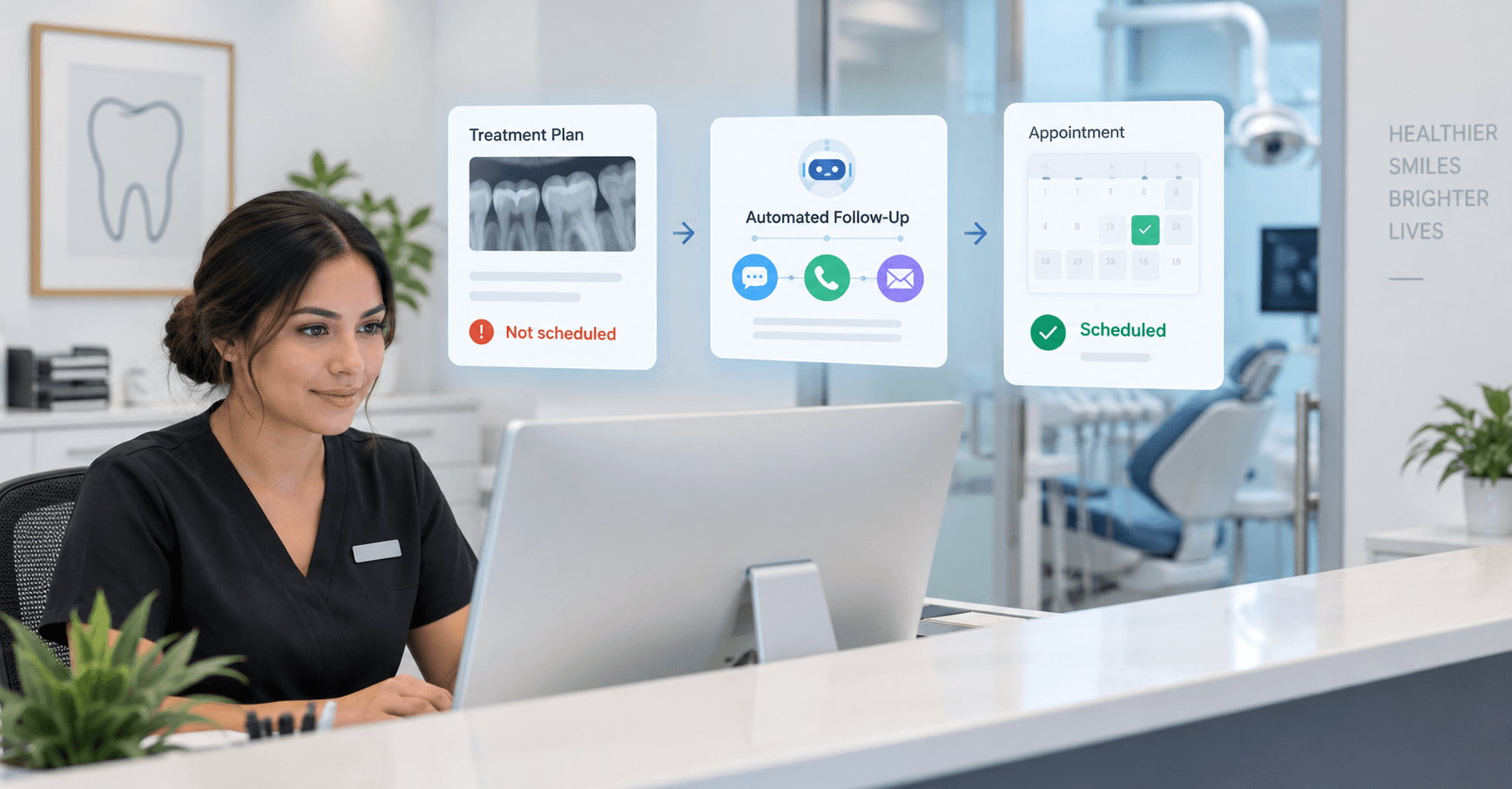
Unaccepted treatment plans become lost production when follow-up depends on someone remembering to call. The fix is to trigger outreach whenever recommended treatment remains unscheduled automatically, then continue until the patient books, declines, or needs staff help. This gives every dental treatment plan follow-up a clear next action without adding another manual task to an already busy front desk.
Summary
Patients leave dental offices every day with recommended treatment they have not scheduled. Once they walk out, follow-up often competes with ringing phones, check-ins, insurance questions, and other immediate front-office work. Across a DSO, those missed follow-ups can turn into a growing pool of diagnosed but unscheduled treatment. Myna, Birdeye's Operations AI Coworker, can help make that follow-up part of an always-on front-office operation instead of another manual callback list.
Why do treatment plans go untouched after a patient leaves?
Staffing pressure already leaves many dental teams stretched thin. The 2025 Dental Economics, Levin Group Annual Practice Survey found that 76% of responding dental practices had at least one open position to fill.
When teams are already covering staffing gaps, treatment plan follow-up has to compete with calls, check-ins, cancellations, insurance questions, and patients standing at the front desk.
Consider Emily. During an examination on Monday, her dentist finds a damaged molar and recommends a crown. Emily understands the recommendation but wants to check what her insurance will cover before scheduling, so she leaves without booking.
That is often where the process starts to break.
Unless the practice has a defined follow-up workflow, nothing will prompt staff to contact Emily in three days, and no deadline will exist to resolve the treatment plan.
On Thursday, the treatment coordinator plans to call her but gets pulled into other work. A week later, Emily is still listed as having diagnosed, unscheduled treatment. A month later, her treatment plan is still sitting unscheduled.
Several factors make this harder across a DSO:
- Ownership is unclear: Follow-up may sit between the treatment coordinator, front desk, and clinical team.
- Volume quickly outgrows manual tracking: What looks manageable at one office becomes difficult to sustain across dozens or hundreds of locations.
- Processes vary by location: One office may follow up consistently while another relies on staff memory.
- Unscheduled treatment can remain invisible: By the time operations teams see an aging backlog, the patient may have moved on or forgotten the urgency of the recommendation.
By month three, the practice may no longer know whether Emily is still considering treatment, concerned about cost, waiting to schedule, or receiving care elsewhere.
Nothing went wrong with the diagnosis. The process simply stopped.
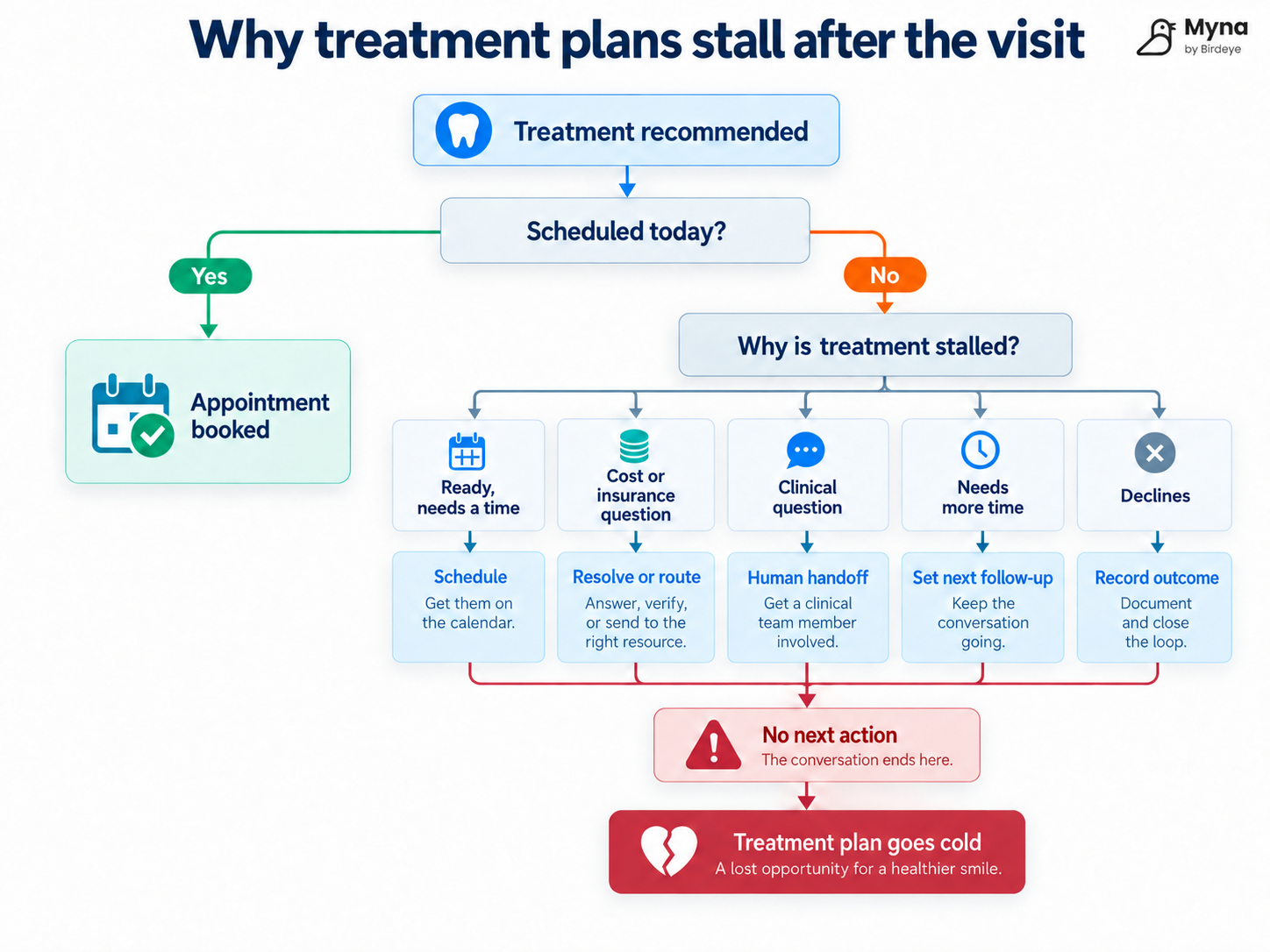
At one dental practice location, Emily may look like a missed callback. Across hundreds of locations, patients like her can become a growing backlog of diagnosed care with no clear next action.
What is the revenue impact of unaccepted treatment plans across a DSO?
An unscheduled treatment plan represents diagnosed care that has not yet turned into scheduled production. One case may seem small, but across hundreds of providers and locations, unresolved crowns, implants, restorative procedures, and other recommended treatments can add up to a significant pool of potential production.
Patients also leave treatment unscheduled for many different reasons. A systematic review of 233 studies across 49 countries identified 101 factors that influence dental treatment decisions, with out-of-pocket costs and dental fear among the most frequently reported. That means an unscheduled treatment plan does not necessarily signal a dental practice “no.” The patient may still be weighing cost, timing, treatment concerns, or other factors.
At the same time, many practices have room to treat more patients. In Q1 2026, the ADA Health Policy Institute study found that 32% of dentists said they were not busy enough and could have treated more patients.
For DSO leaders, that creates an important operational opportunity. When already-diagnosed treatment remains unresolved while appointment capacity is available, better follow-up can help move interested patients back toward the schedule.
Consider a DSO with $2 million in diagnosed, unscheduled treatment across its locations. If systematic follow-up helps move just 5% of that treatment onto the schedule, that represents $100,000 in potential scheduled production. At a 10% recovery rate, the opportunity rises to $200,000.
The exact number will vary by DSO, but the point is the same. Even a small improvement in follow-up can turn a large backlog of unresolved treatment into meaningful production.
How can DSOs build a treatment plan follow-up workflow?
A scalable treatment plan follow-up process should begin as soon as recommended treatment remains unscheduled. From there, the workflow should identify what is holding the patient back, determine the right next action, and keep the case moving until it reaches a clear outcome.
Here’s what that follow-up workflow should include:
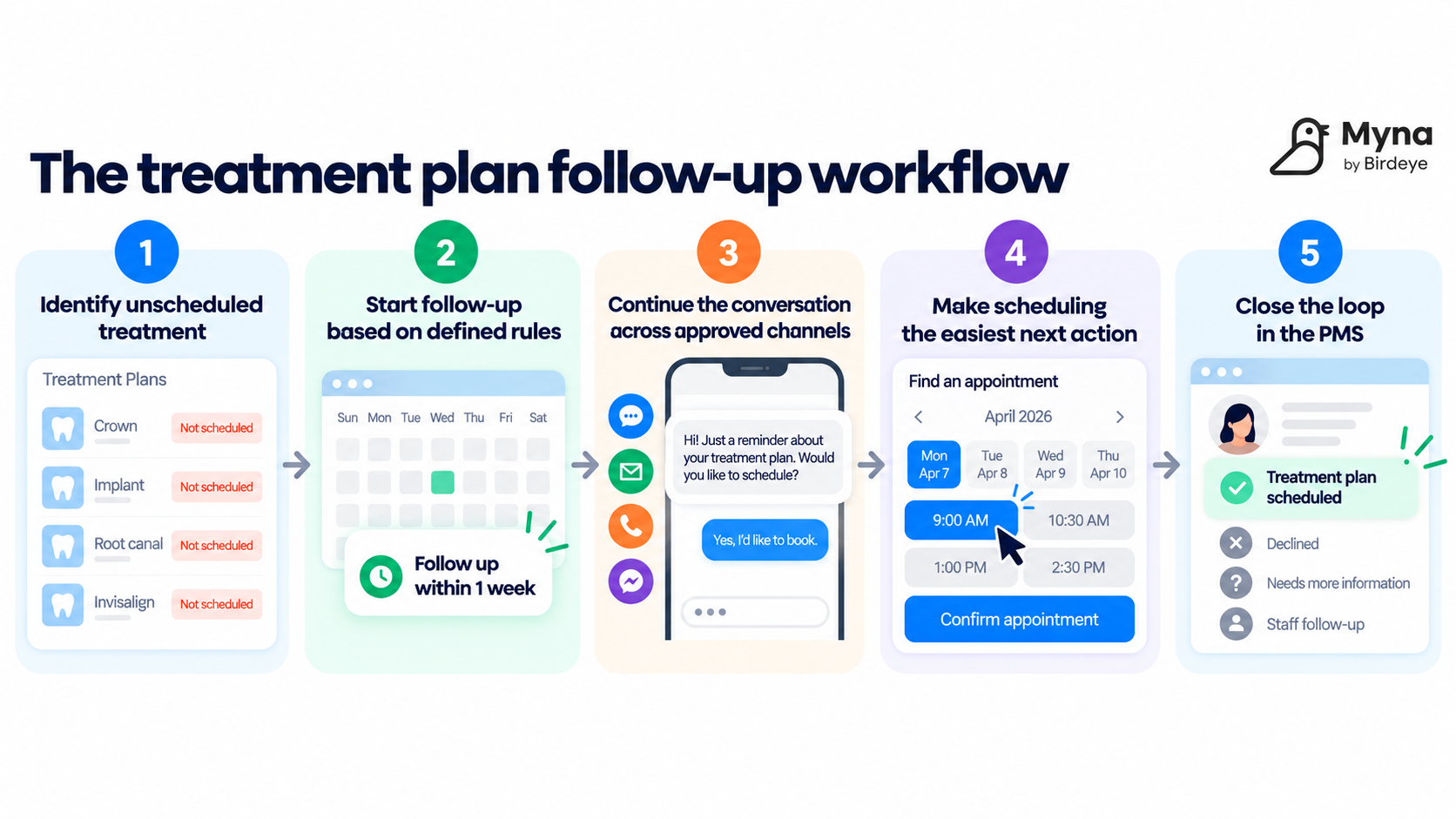
- Identify unscheduled treatment automatically
Use PMS data to surface treatment plans that have been presented but do not have a corresponding appointment, instead of asking teams to build lists manually.
- Start follow-up based on defined rules
Follow-up should start while the treatment conversation is still fresh. The ADA advises that patients who need more extensive treatment should ideally return within one week to discuss their options, noting that the longer reappointment is delayed, the less likely patients are to return.
That makes timing an important part of the workflow. DSOs should define when outreach begins, how often it continues, and what happens if the patient does not respond. The cadence may vary by treatment type, patient status, or organizational policy.
- Continue the conversation across approved channels
Patients may respond to a text even when they ignore a phone call. Follow-up should fit the communication channels the DSO already supports rather than depend on repeated manual calling.
- Make scheduling the easiest next action
Once a patient is ready, the process should move directly toward finding an appropriate appointment instead of generating another message for staff to return later.
- Close the loop in the PMS
The outcome should return to the system of record. If the patient schedules, declines, needs more information, or requires staff intervention, the next person should know what already happened.
Automation does not mean pressuring patients until they book. The goal is consistent, useful follow-up that gives every patient a clear next step while respecting their decision.
How does Myna help DSOs follow up on unaccepted treatment plans?
Myna is Birdeye's Operations AI Coworker, powered by coordinated AI agents that help enterprise dental organizations with hundreds and thousands of locations run high-volume front-office workflows 24/7.
For treatment plan follow-up, Myna's Treatment Plan Coordinator Agent works within the same coordinated system that handles other patient interactions.
Here’s how the workflow moves forward:
- Follow up automatically: When recommended treatment remains unscheduled, the Treatment Plan Coordinator Agent reaches out across voice, text, chat, and email without waiting for a staff member to notice the gap.
- Continue the conversation: It addresses approved cost or scheduling questions and guides interested patients toward the right next step.
- Move ready patients into scheduling: When a patient is ready to book, Myna’s Front Desk Agent uses live availability to schedule the appointment.
- Write the outcome back to the PMS: The interaction is recorded in the PMS, so staff can see whether the patient scheduled, needs more help, or requires another action without maintaining a separate callback list or tracker.
Myna’s agents share one patient context; as a result, the workflow does not stop at outreach. A follow-up moves directly into scheduling, routes a financial question appropriately, or triggers human involvement when the conversation falls outside Myna's approved scope.
What this means for DSOs: Broader follow-up coverage, fewer stalled treatment plans, and less pressure on front-office teams.
How can DSOs turn treatment plan follow-up into a system?
A patient leaving without scheduling should mark the beginning of the next workflow, not the end of the treatment conversation.
For DSOs, the opportunity is to move beyond spreadsheets, callback lists, and staff memory. Automatically identifying unscheduled treatment, maintaining consistent outreach, connecting ready patients to scheduling, and recording every outcome can help recover front-office capacity while giving more treatment plans a clear next step.
See how Myna can help your DSO turn unresolved treatment plans into an active, coordinated follow-up process.
FAQs
About the Author
Somya is a Content Editor at Birdeye with 9+ years of experience in content management, primarily supporting B2B SaaS brands. She brings a strong command of content strategy, SEO, GEO, and editorial planning, along with a sharp eye for crafting narratives that engage and convert. Over the years, Somya has helped scale content operations, optimize digital presence, and drive organic growth & AI visibility for fast-paced tech companies. When she’s not writing or immersed in editorial calendars, you can find her playing with her dog, Kaizer. Connect with Somya Yesodharan on LinkedIn.