

A canceled appointment creates an open slot, and a patient on the waitlist could fill it. Learning how to automatically fill canceled appointment slots matters because matching the two manually takes staff time, and the slot can sit empty anyway.
Medical Group Management Association (MGMA) benchmarking data shows how often that actually happens. Across single-specialty practices, the aggregate cancellation rate reached 19.95% in 2024, and only 27.4% of those canceled visits were rescheduled within 30 days. It points to the same pattern this piece is about: most cancellations in a typical practice never make it back onto the schedule before the opportunity passes.
The real problem behind how to automatically fill canceled appointment slots is connecting an available appointment with the right patient quickly enough. In a health system or DSO, that match involves more than availability.
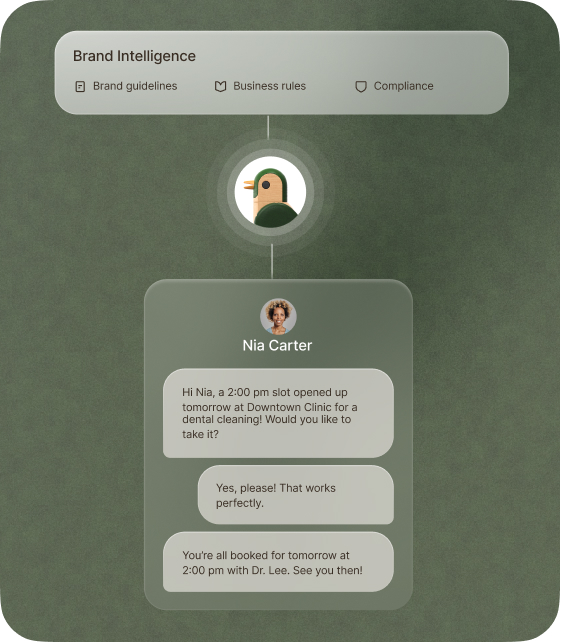
That's exactly the gap Myna, Birdeye's Operations AI Coworker, is built to close. When a cancellation hits the schedule, Myna's Waitlist Agent can identify a patient who fits the appointment criteria and begin outreach as soon as the opening becomes available.
When that process stays manual, it depends on already-busy front-desk staff catching it before the moment passes.
Why do canceled appointment slots go unfilled?
A cancellation creates an opportunity only if someone can act on it quickly. The longer an opening sits, the harder it becomes to match the right patient to the right provider, location, appointment type, and time.
A patient cancels a 2 PM appointment at 8 AM. The front desk sees the opening and checks the waitlist, which includes several patients requesting earlier appointments. Now the manual work begins: find who fits the appointment type, check the provider and location, call patients one at a time, wait for a response, and update the schedule once someone accepts.
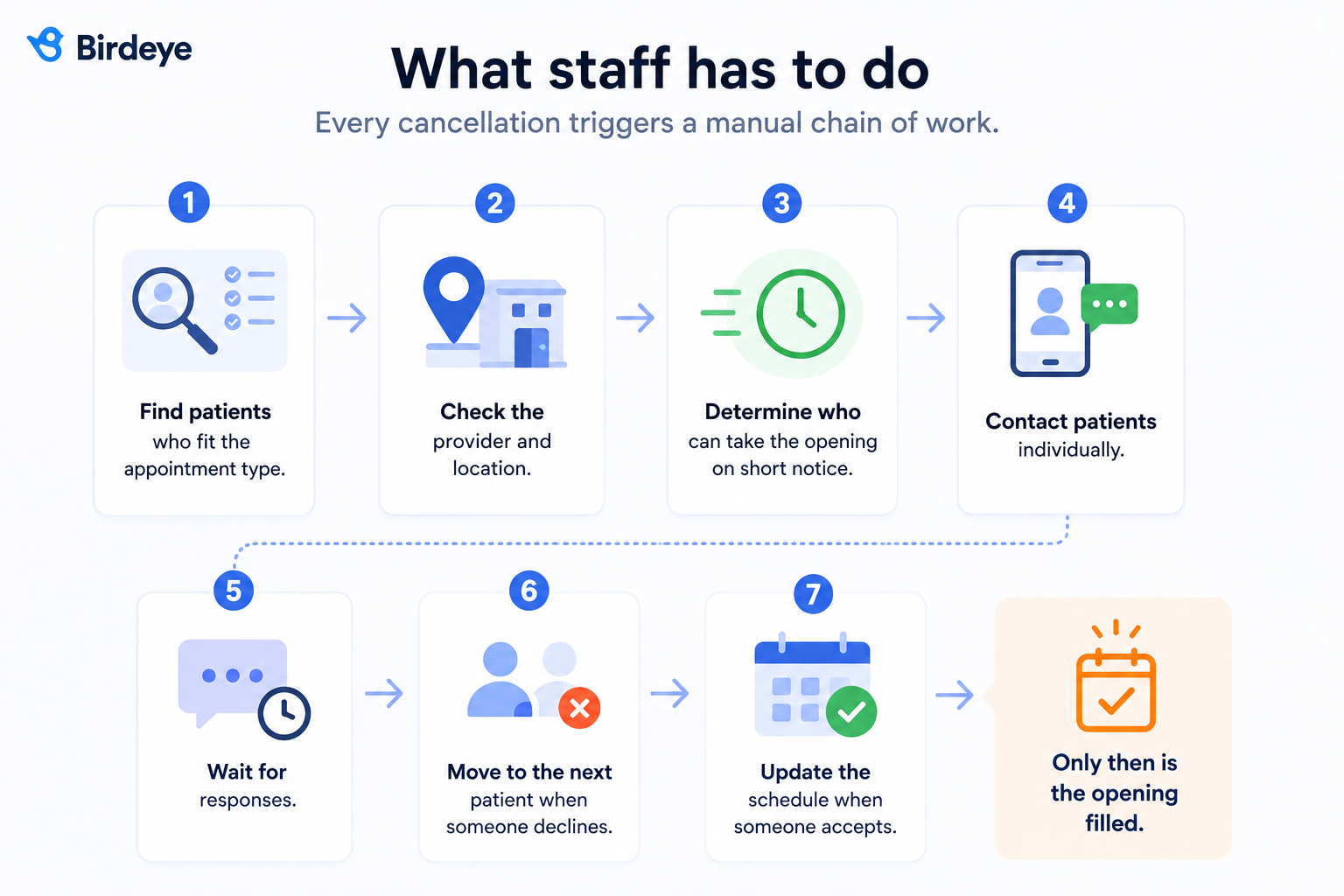
A waitlist stores demand, but it doesn't automatically match that demand to newly available capacity. That’s the actual gap, and how to automatically fill canceled appointment slots comes down to connecting the two sides fast enough for the match to still matter.
What should an automated waitlist consider before filling a canceled appointment?
An automated waitlist needs to evaluate both the open appointment and the patient. The right match depends on more than who wants an earlier slot. It has to account for scheduling rules, appointment requirements, and whether a given patient can actually use that specific opening.
For the appointment, that means the provider, location, appointment type, duration, timing, and scheduling constraints. For the patient, it means their appointment needs, eligibility, preferences, and whether the opening fits their circumstances.
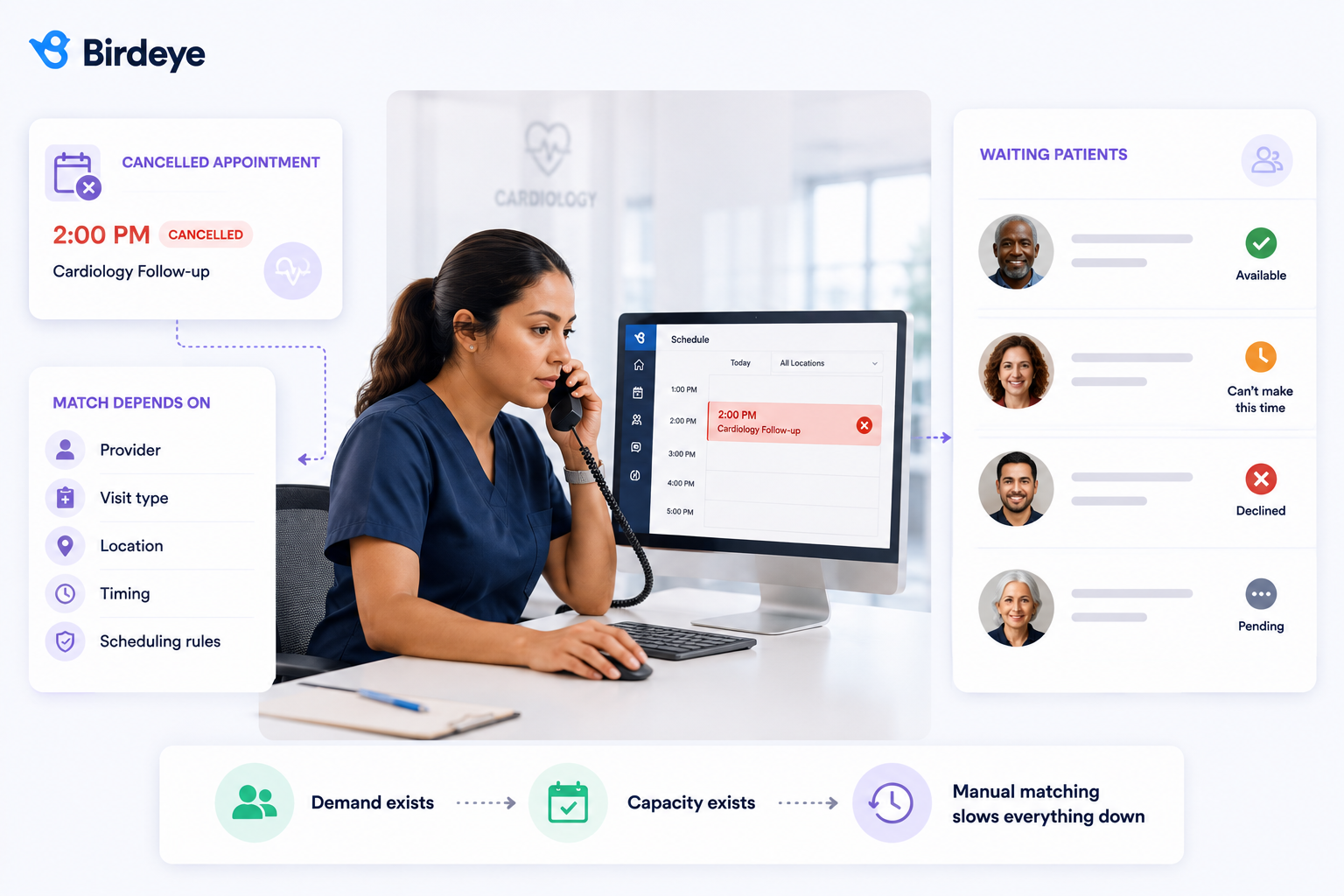
That is where manual recovery becomes difficult. A coordinator may need to check these details, contact patients, wait for responses, and update the schedule after someone accepts. Those steps happen alongside calls, check-ins, insurance questions, and other front-desk work.
An automated workflow should handle that matching and outreach without treating the waitlist as a simple list of names. The goal is to connect the right patient to the right opening while following the organization's scheduling rules.
How much does an empty appointment slot really cost?
An empty appointment slot represents unused clinical capacity. The clinician, room, and supporting resources were available, but the scheduled time was not converted into a completed visit.
Recovering that capacity also takes staff time, a cost this piece covers in more detail below.
For multi-location organizations, the impact compounds because the same recovery process may run across hundreds of providers, appointment types, and locations.
Faster cancellation recovery helps recover scheduled capacity, reduces repetitive work for staff, and helps improve patient satisfaction by moving waiting patients into earlier appointments.
What does the research say about automated waitlists?
Recent research shows that automated waitlists can recover appointment capacity, although results vary by implementation.
A 2026 study, Automated Waitlists for Ambulatory Appointment Scheduling: Multisite, Mixed Methods Evaluation, examined 127 U.S. health systems. Among the 10 high-performing systems in the study, 38.8% of appointments offered through the automated waitlist were filled.
The study also found that effectiveness depended on how well the technology fit into broader scheduling infrastructure. Insurance requirements, scheduling rules, specialty constraints, and organizational processes all affected performance.
That second finding matters just as much as the first. How to automatically fill canceled appointment slots is not a question of automating a list. It is a question of automating the workflow that starts when an appointment becomes available. The goal is to automate the workflow that starts when an appointment becomes available.
Why doesn't manual waitlist outreach scale?
Manual waitlist outreach becomes harder as organizations add locations, providers, specialties, and appointment types. Each opening can require a different set of scheduling rules and patient criteria.
Staff also have competing priorities. A cancellation may arrive while someone is checking in a patient, answering a call, or verifying insurance.The waitlist then becomes another queue competing for the same staff time, a common pain point that patient engagement tools try to address.
Medical Group Management Association's (MGMA) February 2026 poll found that scheduling was the top area where medical practices wanted to add AI or automation. It accounted for 31% of responses, with leaders specifically citing canceled appointments, slot utilization, and automated waitlists.
How to automatically fill canceled appointment slots comes down to automatic appointment slot matching that closes that gap directly.
Effective cancellation recovery should connect an open slot to a matching patient without requiring staff to manually work through the list.
How does Myna automate real-time waitlist matching?
Myna, Birdeye's Operations AI Coworker, coordinates front-office work across enterprise healthcare and dental organizations. Its agents share patient context, so the workflow can move from an open slot to patient outreach and scheduling without staff manually working through the waitlist.
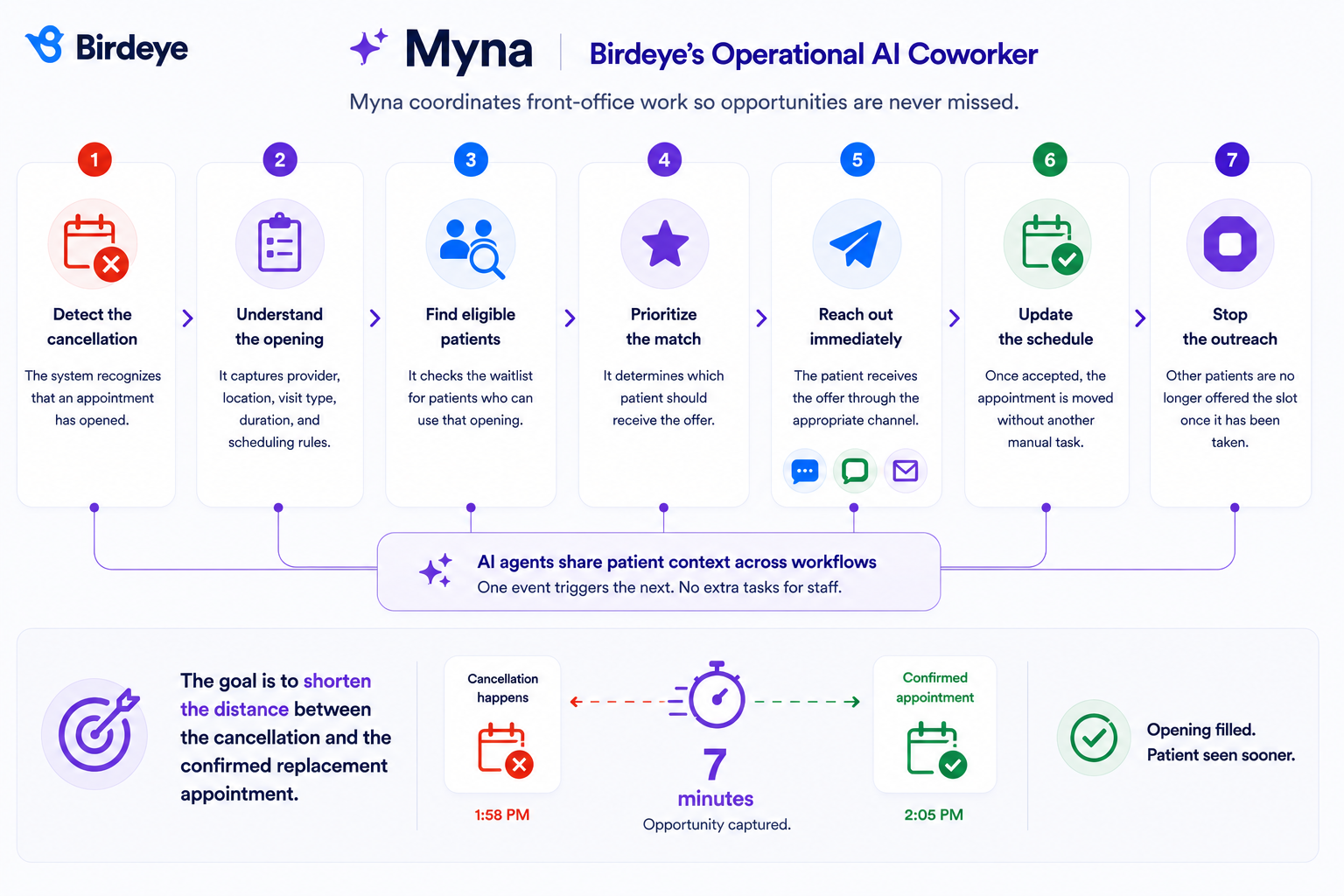
For this workflow, the Front Desk Agent handles appointment workflows, while the Waitlist Agent acts on newly available capacity. Both work from shared patient context, so the workflow can account for the information needed to support the match.
For health systems and DSOs working out how to automatically fill canceled appointment slots, Myna is designed to work within existing front-office processes rather than replace staff judgment. No one has to remember to check the waitlist or cross-reference provider, visit type, and insurance before making a call.
A slot that opens at 1:58 PM can be filled by 2:05 without a staff member picking up the phone, and when a case needs judgment, an unusual conflict, or a clinical question, it gets summarized and routed to staff with the relevant context. Staff still make the calls that require judgment, following an AI human-in-the-loop model.
That distinction matters at enterprise scale. With Myna at work, the goal is not to remove people from the process. It is to reserve their time for decisions that actually require them.
How should health systems and DSOs measure canceled-slot recovery?
Start with the point where scheduled capacity becomes available, and track it across locations:
| Metric | What it reveals |
| Cancellation rate | How often scheduled capacity becomes available |
| Waitlist match rate | How often open slots find a matching patient |
| Offer acceptance rate | How often patients accept replacement appointments |
| Fill rate | How many canceled slots are ultimately recovered |
| Time to refill | How quickly an opening becomes a new appointment |
| Staff touches per cancellation | How much manual work recovery requires |
A slot filled two days later is not equivalent to a slot filled two hours later. The closer the replacement appointment is to the cancellation, the more likely the organization is to recover the capacity it already scheduled.
For enterprise organizations, segment these metrics by location, specialty, provider, and appointment type. A strong organization-wide fill rate can hide weak performance at individual locations or specialties.
How to automatically fill canceled appointment slots at scale?
The short answer to how to automatically fill canceled appointment slots is that when a cancellation happens, the system should understand the opening, find matching patients, make the right offer, and update the schedule when someone accepts. That removes the manual scramble between cancellation and replacement appointments.
For health systems and DSOs, that approach can help recover capacity without adding another manual queue for front-desk teams.
Myna is built around that model. Its coordinated agents help translate changes in appointment availability into completed front-office actions, while staff retain control over situations requiring human judgment.
If your organization already has a waitlist, measure how quickly canceled slots are offered, accepted, and refilled. That will tell you whether your waitlist is actually recovering capacity or simply storing demand.
See how Myna can automate appointment recovery and waitlist workflows across your organization.
FAQs
About the Author
Shruti Dugar is a Senior Content Marketing Writer with 11+ years of experience in content and storytelling. At Birdeye, she writes about how AI coworkers help multi-location brands win AI visibility and deliver seamless customer experiences. She’s also a published author & enjoys traveling. Connect with Shruti Dugar on LinkedIn.