
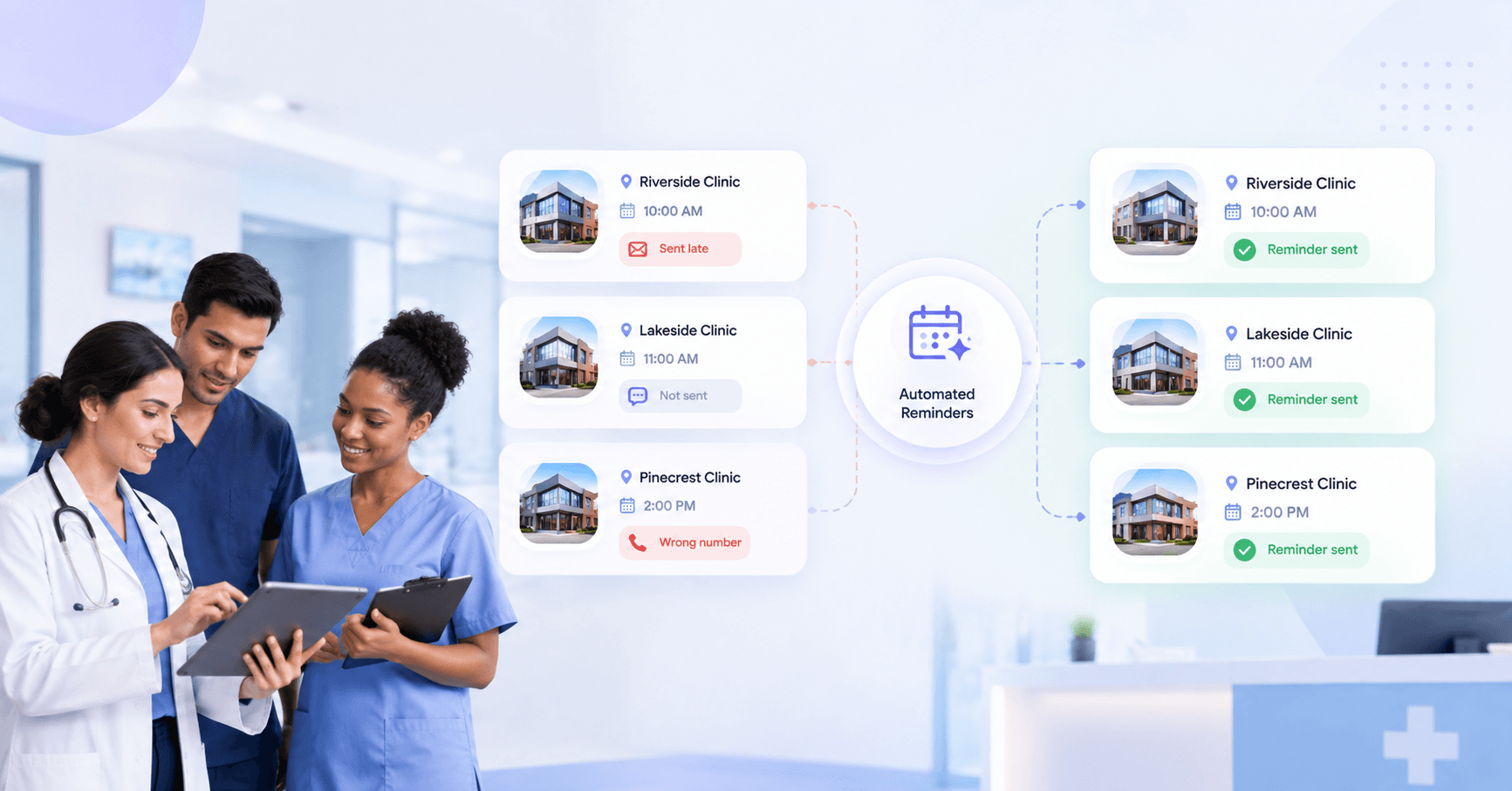
Knowing how to cut patient no-shows without hiring more staff matters because an empty appointment slot represents unused clinical capacity. In 2025, a Medical Group Management Association (MGMA) poll found that 27% of medical practices reported an increase in patient no-show rates.
Most health systems and DSOs already send appointment reminders. The harder problem is executing that process consistently across locations.
One location sends reminders on schedule. Another falls behind when the front desk gets busy. A third handles follow-up differently. Those differences can turn a standardized reminder policy into inconsistent patient communication, which makes it harder to improve patient satisfaction across locations.
The solution to how to cut patient no-shows without hiring more staff is to standardize the reminder workflow so execution does not depend on who is working that day.
Keep reading to see where reminder workflows break down and how to make them consistent at scale.
Why does reminder quality vary across locations?
Reminder quality varies when the workflow depends on manual execution. Someone has to identify upcoming appointments, send the right communication, monitor responses, and follow up when a patient needs to change an appointment.
That process can look different from one location to another. One team may have time to follow up promptly. Another may be managing heavy call volume, check-ins, insurance questions, and other front-office work.
Those differences may not appear in the organization's policy. They show up in execution, where they can contribute to different no-show rates across locations.
How does one missed reminder turn into a no-show?
A patient books a follow-up six weeks out. The appointment is on the schedule, but the reminder depends on a busy front desk.
If the reminder arrives late or the patient has no simple way to confirm or reschedule, the opportunity to resolve the issue shrinks. Without another opportunity to act, the patient may miss the appointment.
A useful reminder does more than communicate a date and time. It gives the patient a chance to act before the appointment:
- Confirm the visit.
- Request a different time.
- Cancel with enough notice to reopen the slot.
That last point matters operationally. An early cancellation gives the organization more time to offer the opening to another patient, a process covered in how to automatically fill canceled appointment slots.
Do appointment reminders actually reduce no-shows?
Yes. Recent research supports automated appointment reminders as an effective way to improve attendance, although the impact varies by patient population and workflow.
A 2024 systematic review and meta-analysis examined the effectiveness of text-message reminders for pediatric appointment adherence across multiple studies. The review found that text-message reminders improved appointment attendance, which supports HIPAA-compliant text messaging as a practical tool for reducing missed visits.
The evidence also points to an important operational detail: reminders work best as part of a broader appointment workflow. Patients need a clear way to confirm, cancel, or reschedule when their plans change. That response gives the organization time to recover the appointment slot instead of waiting for a no-show.
A 2025 study of more than 81,000 appointments at a university hospital found that SMS reminders were associated with a lower risk of no-shows. The study also found that an increase in SMS reminder use from 11.4% to 25.4% coincided with a decline in no-shows.
That evidence supports the larger operational point. Sending reminders is only one part of how to cut patient no-shows without hiring more staff, because the workflow also needs to capture patient responses and act on them consistently.
Why doesn't staff training solve the inconsistency in reminders?
Training can improve reminder execution, but how to cut patient no-shows without hiring more staff depends on removing the dependency on staff time. Front-desk teams already manage check-ins, calls, scheduling, insurance questions, and patient requests.
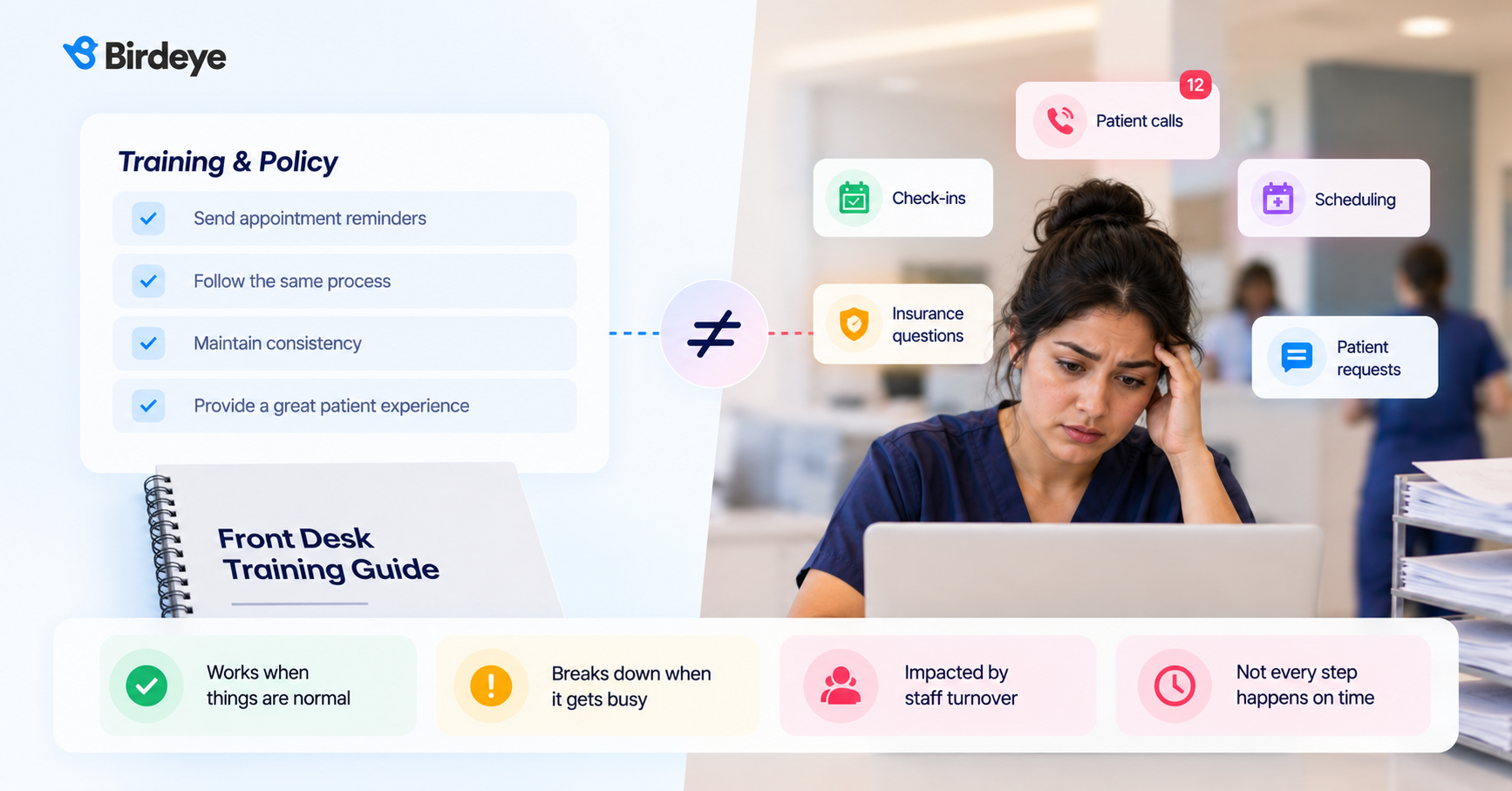
Workloads also change. Staff take time off, teams turn over, and call volume can spike. A process that works reliably under normal conditions can break down when a location gets busy.
A process can be standardized on paper while execution stays inconsistent. That gap is exactly what shows up across a health system or DSO running many locations. A policy can define the reminder process, but it cannot guarantee that every step happens on time.
What should a standardized reminder workflow actually do?
A consistent reminder workflow should be driven by the appointment schedule rather than by someone's memory or task list.
It should:
- Identify upcoming appointments automatically. Every eligible appointment enters the reminder workflow.
- Apply defined timing rules. Reminders go out according to the organization's workflow.
- Use the appropriate communication channel. Patients receive communication through the channels the organization supports, and patient engagement tools vary in which channels they cover.
- Give patients a clear next step. They can confirm, cancel, or request a different appointment when the workflow allows it.
- Capture responses and trigger follow-up. Patient responses become part of the appointment workflow, with unresolved changes moving to the appropriate next step.
The same operating logic should apply across locations, even when patient and appointment details differ. How to cut patient no-shows without hiring more staff is not about sending more reminders. It is about making the process predictable, repeatable, and connected to scheduling.
How much do no-shows cost at scale?
No-shows create more than an unused appointment, and they can undermine dental patient retention strategies. They also create follow-up work for staff and can delay access for patients who need care.
Staff may need to contact the patient, reschedule the visit, document the interaction, and manage the resulting schedule gap. Across multiple locations, that recurring work competes with other front-office responsibilities.
The impact also varies by appointment type and location. A specialty visit, dental chair, or procedure slot may be harder to recover than a routine appointment.
That's the real cost of a no-show. It is not just the empty slot, but the lost chance to fill it in advance.
How does Myna standardize appointment reminders across locations?
Myna, Birdeye's Operations AI Coworker, coordinates front-office workflows across enterprise healthcare and dental organizations. Its agents share patient context, allowing reminder activity to connect with appointment workflows rather than operate as a separate communication task.
Myna's Reminder Agent supports automated appointment reminders, while the Front Desk Agent handles appointment actions such as booking and rescheduling. A patient response can move into the appropriate workflow rather than becoming another task for the front desk to track.
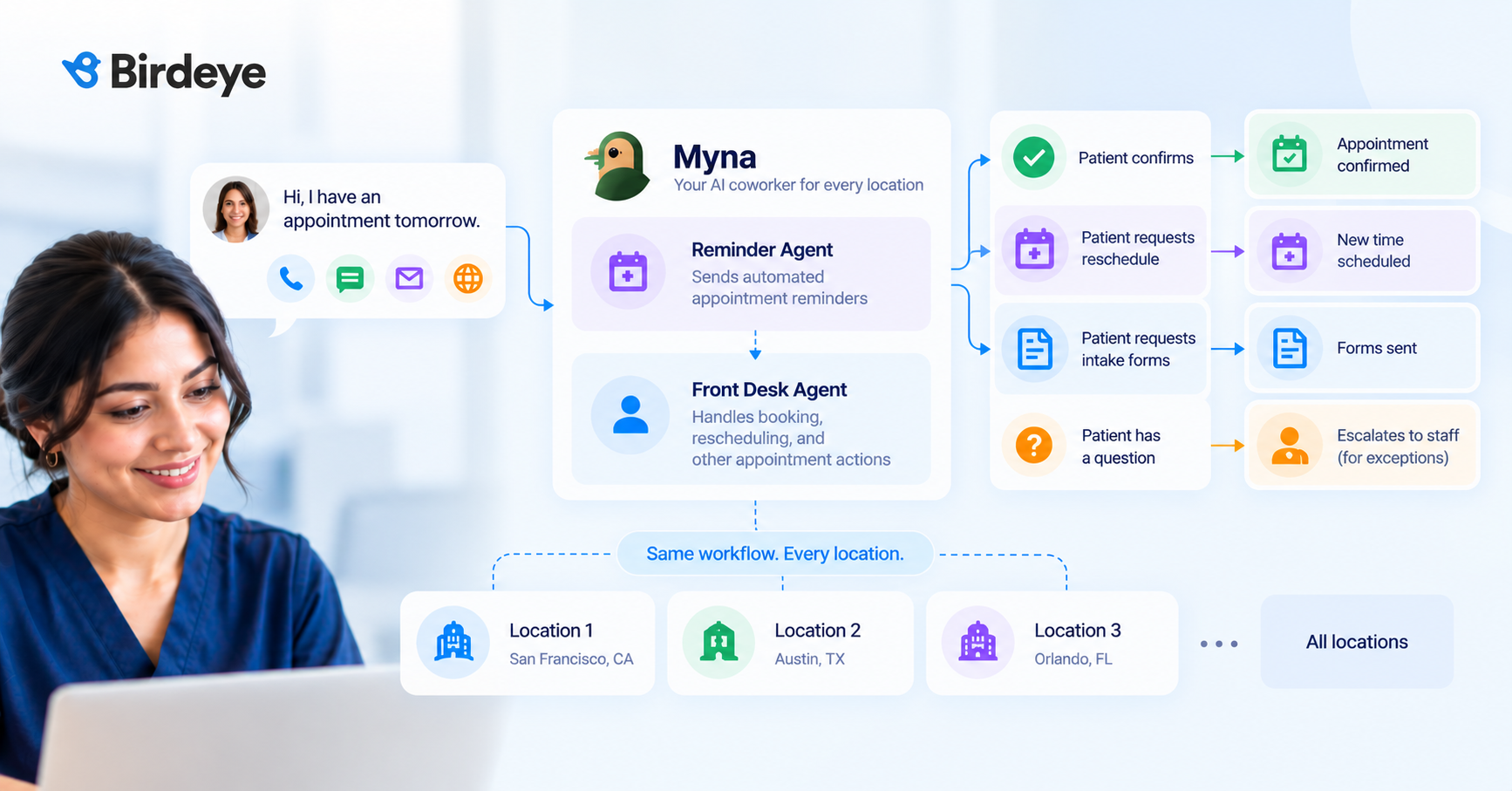
This matters across multiple locations, because how to cut patient no-shows without hiring more staff depends on running the same underlying workflow everywhere. Organizations can standardize the underlying workflow while still applying the patient, appointment, and location context needed for each interaction.
Staff retain judgment on exceptions and situations requiring human review. Myna handles the volume of recurring reminders and related front-office actions that follow defined workflows.
How should health systems and DSOs measure reminder performance?
To see how to cut patient no-shows without hiring more staff, track the workflow that leads to the outcome, not only the no-show rate:
| Metric | What it reveals |
| No-show rate | How often scheduled patients do not attend |
| Reminder completion rate | Whether eligible appointments entered the reminder workflow |
| Reminder delivery rate | Whether reminders reached patients |
| Confirmation rate | How often patients confirm appointments |
| Reschedule rate | How often patients change appointments instead of missing them |
| Cancellation lead time | How much notice the organization receives |
| No-show rate by location | Where performance varies |
| No-show rate by appointment type | Which visit types have higher attendance gaps |
For enterprise organizations, the location-level view mattersthe most. One location may have strong reminder execution and low no-show rates, while another has inconsistent follow-up and a higher no-show rate.
Look at the reminder workflow alongside the no-show rate. That shows whether the problem is patient behavior, process execution, or both.
FAQs
How to cut patient no-shows without hiring more staff?
Standardize the reminder workflow. Automate recurring communication. Give patients a clear way to confirm, cancel, or reschedule. Measure performance by location so operational teams can see where the process breaks down.
The goal is to make the reminder workflow consistent enough that staff availability no longer determines whether it happens.
For health systems and DSOs, that means protecting appointment capacity without adding another recurring task to the front desk.
Myna supports that model by coordinating reminder and appointment workflows through shared patient context, bringing front-office automation into the same operating workflow.
The reminder should be automatic. The judgment should stay human, which is the AI human-in-the-loop model.
See how Myna can standardize patient reminders and front-office workflows across your organization.
About the Author
Shruti Dugar is a Senior Content Marketing Writer with 11+ years of experience in content and storytelling. At Birdeye, she writes about how AI coworkers help multi-location brands win AI visibility and deliver seamless customer experiences. She’s also a published author & enjoys traveling. Connect with Shruti Dugar on LinkedIn.