
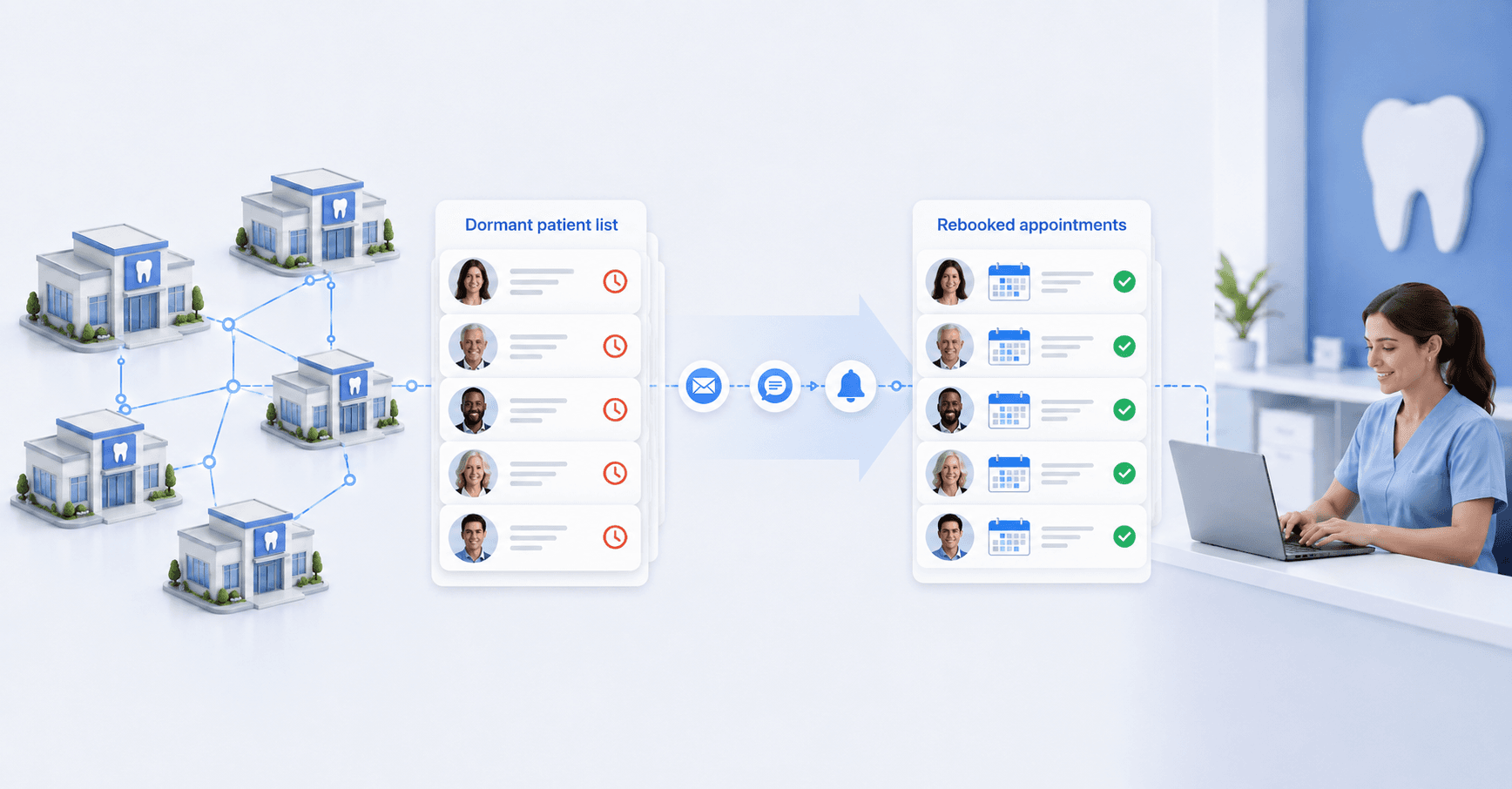
DSOs can reactivate lapsed dental patients without increasing staff by replacing manual recall lists with an automated and governed recall workflow. Instead of relying on front-office teams to manually work through growing lists, automation can continuously identify dormant patients, conduct outreach, follow up, and help move interested patients back onto the schedule.
Summary
Recall lists grow because urgent front-office work takes priority over proactive outreach. As a result, lapsed patients often go untouched for weeks or months, leaving recoverable revenue on the table. Myna, Birdeye’s Operations AI Coworker, helps DSOs make recall an ongoing process by continuously reaching dormant patients, following up, and helping move them back onto the schedule.
How does a typical dental patient's account go dormant?
The path to dormancy can begin before a patient is even overdue. Delta Dental’s 2025 report found that 58% of adults cited scheduling future checkups at the end of an exam as a motivator for making preventive dental visits. When the next visit isn't scheduled, the practice has to rely on recall outreach to bring the patient back.
Consider Sarah, a routine hygiene patient:
- Month 0: Sarah finishes her hygiene visit but doesn't schedule the next appointment.
- Month 6: Sarah receives a single automated SMS stating she is due for a checkup. She reads it while driving, intends to book later, and forgets.
- Month 7: Her account appears on the overdue recall list for manual follow-up.
- Month 9: Staff call during the workday. Sarah misses the call, and staff leaves a voicemail.
- Month 12+: Sarah's record sits untouched. She is not unhappy with her care; she simply slipped through the operational cracks.
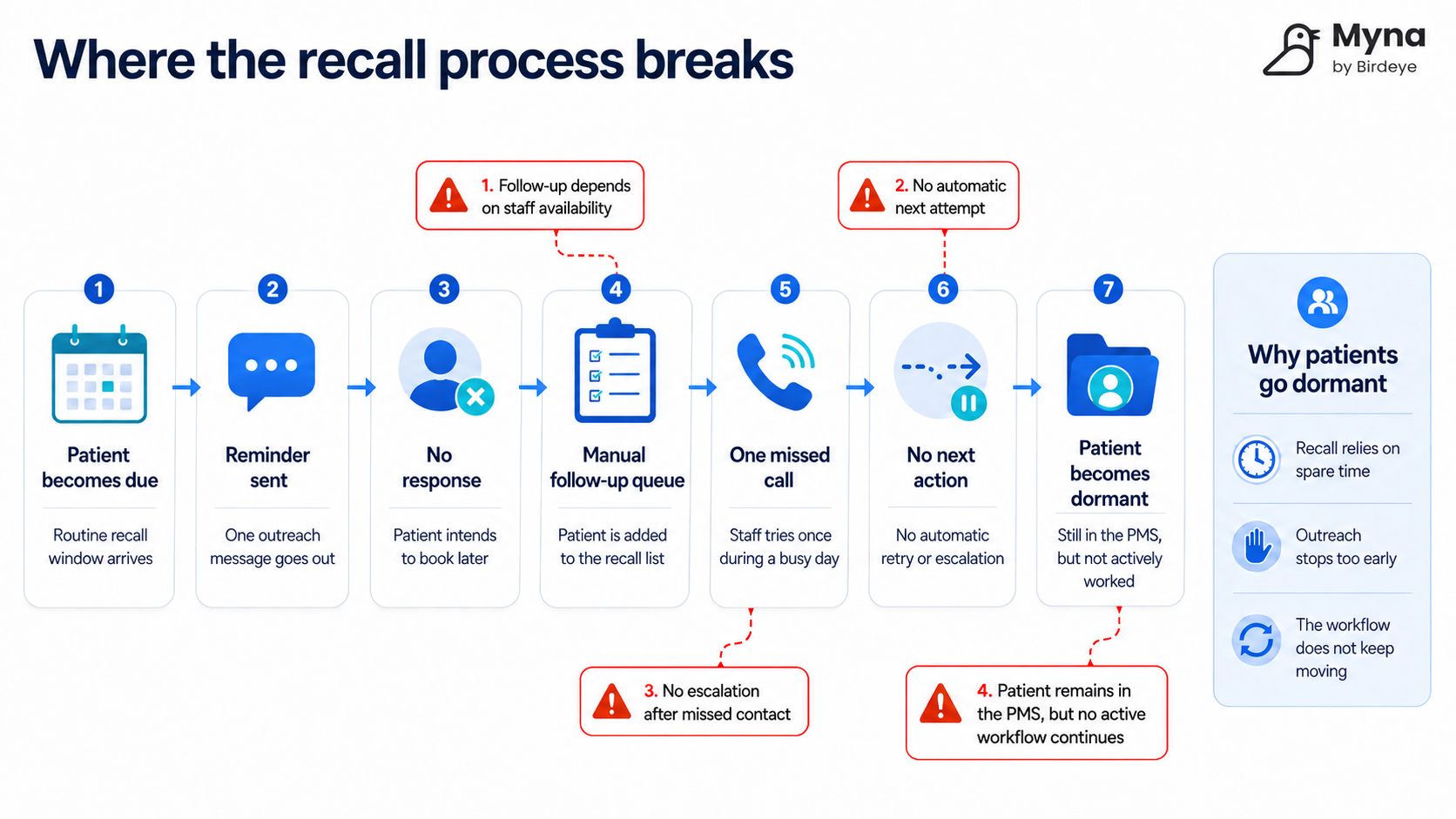
Sarah is not lost to a competitor. She is stuck in practice latency. Multiply Sarah by 300 to 500 patients per location across a multi-location DSO, and the dormant list becomes a significant source of uncaptured revenue.
Why do DSOs' dormant patient lists keep growing?
The American Dental Association recommends that practices should have systems in place to “track and engage dormant patients to keep them active in their healthcare prevention.” Yet at DSO scale, keeping that follow-up moving consistently can become the challenge.
A patient misses their hygiene recall window and lands on a follow-up list. Staff plans to call, but check-ins, cancellations, insurance questions, and ringing phones take priority. The patient stays on the list while more overdue patients are added behind them.
Across dozens of DSO locations, those small delays can turn into hundreds or thousands of dormant patients. That backlog has a financial cost. When recall falls behind, organizations may end up spending more to acquire new patients. This approach increases customer acquisition costs (CAC) while recoverable revenue remains buried in the PMS.
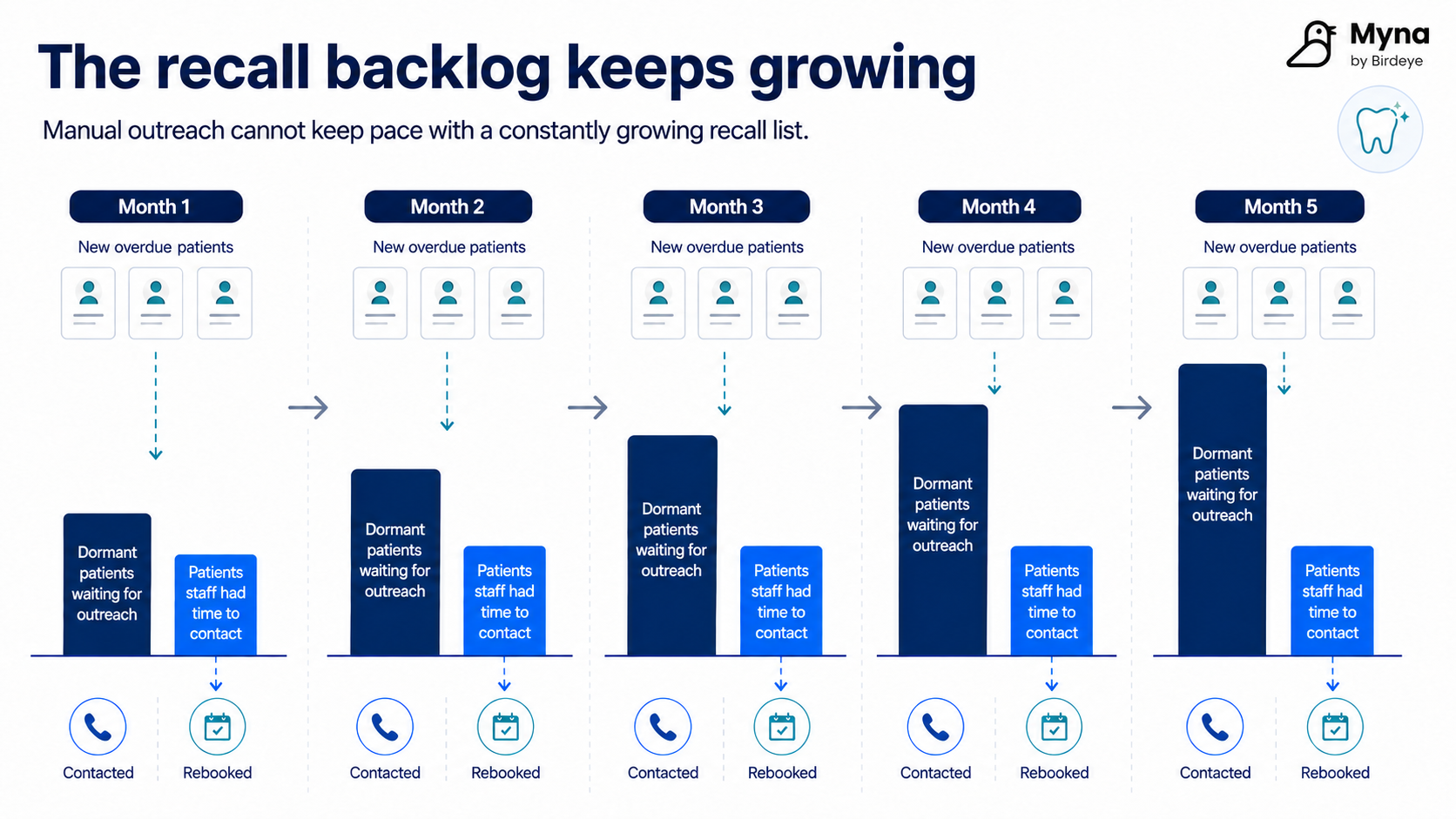
The issue is not staff effort. It is a capacity problem. Manual recall has to compete with urgent front-office work every day, which makes consistent outreach difficult to sustain across locations.
How can DSOs estimate the revenue opportunity in a dormant patient list?
Recovering dormant patients matters even more when practices have room in the schedule. In Q2 2026, the American Dental Association Health Policy Institute research found that one-quarter of dentists said they were not busy enough and could have treated more patients.
For DSOs, one place to find that additional production is in the patient base they already have. Every patient who does not return can mean an unfilled hygiene appointment, delayed treatment opportunities, and revenue tied to an existing relationship that the organization is no longer realizing.
The simplest way to estimate the immediate revenue opportunity is:
Dormant patients × reactivation rate × average realized production per returning patient = estimated revenue
For example, consider a DSO with 10,000 dormant patients, a 1% reactivation rate, and $300 average production per returning patient:
10,000 × 1% = 100 returning patients
If those returning patients generate an average of $300 in realized production from their first return visit:
100 × $300 = $30,000 in estimated revenue production
Increase the reactivation rate to 5%, and the same assumptions would represent 500 returning patients and $150,000 in estimated production.
These figures are illustrative, not industry benchmarks. Every DSO should use its own dormant patient count, historical reactivation rate, and realized production data.
The point is not the exact dollar figure. A dormant patient list is more than an operational backlog. It represents existing patient relationships with revenue potential that can keep growing every month the recall process falls behind.
Why don't periodic dental patient recall campaigns solve a continuous problem?
Periodic dental patient recall campaigns fall short because patients become overdue every day, while outreach happens only in bursts.
The pattern is usually familiar:
- The recall list grows: Staff export and clean a backlog of overdue patients.
- Outreach ramps up: Teams spend several days making calls and sending messages.
- Some patients rebook: The list gets smaller temporarily.
- Daily operations take over: Recall moves down the priority list again.
- The backlog rebuilds: New patients become overdue while older patients still need follow-up.
The problem is structural. A continuous inflow of overdue patients cannot be managed effectively with occasional outreach.
What should an always-on DSO recall workflow look like?
An effective recall workflow should keep moving without depending on staff to restart it manually. It should continuously identify overdue patients, conduct outreach, follow up, and move interested patients toward scheduling.
For DSOs, that means connecting six stages:
| Stage | What should happen |
|---|---|
| Identify | Patients who enter the workflow automatically when they meet the DSO’s defined recall criteria. |
| Reach | Outreach begins through approved channels such as text, voice, or email based on patient preferences and applicable requirements. |
| Follow up | Patients who do not respond receive appropriate follow-up instead of returning to an untouched recall list. |
| Book | When a patient is ready to return, the workflow connects them to appropriate appointment availability. |
| Record | Contact outcomes, scheduling activity, and patient responses should flow back into the system of record. |
| Escalate | Route clinical questions, exceptions, or conversations requiring judgment to staff with the relevant context. |
The key is that these stages should operate as one connected workflow, not as separate tasks that staff have to hand off manually. The next question is how a DSO can automate and run that process consistently across locations.
How does Myna help DSOs reactivate lapsed patients?
Myna, Birdeye’s Operations AI Coworker, helps DSOs move patient recall from a manual backlog to an automated workflow. Powered by a coordinated team of AI agents, Myna can reach dormant patients across every location, even when front-office teams are at capacity.
Keep recall outreach running continuously
Myna’s Recall Agent can continuously engage patients who are overdue for care across voice, text, chat, and email and keeps outreach moving based on the DSO’s defined workflows. This gives DSOs consistent recall capacity without relying on staff to find time between calls, check-ins, insurance questions, and other daily demands.
Connect recall directly to scheduling
Myna’s eight specialized AI agents share the same patient context, allowing one front-office action to trigger the next. When the Recall Agent reaches a dormant patient who is ready to return, it can coordinate with the Front Desk Agent to:
- Check the patient record
- Find live appointment availability
- Present appropriate open times
- Book or reschedule the appointment
Work directly with the PMS or EHR
Myna can read from and write to the systems front-office teams already rely on. Its agents can search patient information, access live scheduling data, and write completed appointments back to the PMS or EHR in real time after Myna completes an interaction.
Escalate conversations that need people
Myna is designed to automate repeatable operational work, not replace human judgment. If a patient asks a clinical question, requires specialized review, or falls outside the approved workflow, Myna can summarize the interaction and route it to staff with the relevant context attached.
For DSOs managing large dormant patient lists across multiple locations, Birdeye’s Operations AI Coworker, Myna, turns recall from an occasional catch-up exercise into a repeatable operating process.
How can DSOs capture untouched revenue by reactivating dormant patients?
Dormant patient lists don't grow because of a lack of staff effort; they grow because manual outbound tasks cannot compete with the daily demands of a busy dental office.
DSOs can change that by treating reactivation as an ongoing operating process, not a periodic project. Consistent outreach keeps more patient relationships active and helps move interested patients back onto the schedule.
The patients are already in your system. The relationship already exists. The question is how long you let that opportunity sit untouched.
Learn how Myna can help your DSO reactivate dormant patients and recover front-office capacity without adding headcount.
FAQs
About the Author
Somya is a Content Editor at Birdeye with 9+ years of experience in content management, primarily supporting B2B SaaS brands. She brings a strong command of content strategy, SEO, GEO, and editorial planning, along with a sharp eye for crafting narratives that engage and convert. Over the years, Somya has helped scale content operations, optimize digital presence, and drive organic growth & AI visibility for fast-paced tech companies. When she’s not writing or immersed in editorial calendars, you can find her playing with her dog, Kaizer. Connect with Somya Yesodharan on LinkedIn.