
Healthcare organizations are using AI agents across clinical decision support, ambient documentation, care coordination, and administrative operations. Across these use cases, the goal is similar: reduce repetitive work while helping teams act on information faster.
At the front office, AI agents in healthcare can manage calls, scheduling requests, insurance questions, and patient follow-ups. They can book appointments, verify insurance, send reminders, complete intake, and update the EHR or PMS. Unlike basic chatbots, they can take approved actions and move work forward while routing exceptions to staff.
Summary
The real value of healthcare AI agents comes from coordinating multiple front-office workflows, not automating one task at a time. Agentic AI can use shared context, workflow triggers, and connected systems to move a patient request from one approved step to the next.
Multi-agent systems extend this model by assigning specialized jobs to different agents while keeping people in the loop for clinical decisions, approvals, and exceptions.
What is an AI agent in healthcare?
An AI agent in healthcare is an autonomous system designed to complete specific healthcare workflows end to end within defined rules and compliance guardrails, including HIPAA requirements. These agents use AI and generative AI technologies, including large language models (LLMs), to understand natural-language requests, interact with connected systems, and take approved actions.
For example, if a patient calls to move an appointment, a basic bot might collect the request and send staff a message. A healthcare AI agent can identify the patient, check live availability, follow scheduling rules, reschedule the appointment, send confirmation, and update the EHR or practice management system.
Adoption is expected to accelerate. Gartner predicts that by 2028, 33% of enterprise software applications will include agentic AI capabilities, up from less than 1% in 2024.
For healthcare organizations, this broader shift reflects a move from AI that primarily assists with information to agents that can execute defined operational workflows.
What front-office jobs can AI agents in healthcare handle?
AI agents in healthcare can support many repetitive workflows that keep a front office running. Common jobs include:
- Answering patient calls, chats, texts, and emails
- Booking, rescheduling, and canceling appointments
- Checking live appointment availability
- Sending confirmations and reminders
- Collecting pre-visit forms and intake information
- Verifying insurance information before a visit
- Answering approved administrative questions
- Taking structured messages after hours
- Filling canceled appointments from a waitlist
- Updating the EHR, PMS, or CRM after an action
Healthcare AI agents can also work outbound. A reminder agent can contact patients before an appointment, while a waitlist agent can react when a slot opens. A pre-visit agent can follow up when required forms remain incomplete. The result is a workflow that keeps moving without requiring staff to manually trigger every next step.
How are healthcare AI agents different from chatbots and answering services?
Healthcare AI agents go beyond answering questions or taking messages. They can follow defined workflows, use live system data, take approved actions, and update the systems healthcare teams already use.
| Capability | Healthcare AI agents | Basic chatbots | Answering services |
|---|---|---|---|
| Primary role | Complete operational workflows | Answer common questions | Answer calls and take messages |
| Uses live system data | Yes, when connected to the EHR, PMS, or CRM | Usually limited | Typically no |
| Takes action | Can book, reschedule, verify, follow up, and update records | Usually provides information or guidance | Routes requests to staff |
| Updates systems | Can write approved actions back to connected systems | Usually no | No |
| Workflow control | Uses defined steps, permissions, and guardrails | Limited conversation logic | Follows call scripts and escalation rules |
| Human oversight | Routes clinical or out-of-scope requests to staff with context | Often redirects or stops | Escalates or leaves a message |
| Cross- workflow coordination | Can coordinate scheduling, reminders, intake, insurance, and waitlists | Usually focused on a single interaction | Primarily focused on call handling |
How do multiple AI agents work together in healthcare?
A multi-agent system uses several specialized agents to complete parts of a larger workflow. Instead of each agent operating independently, AI agent orchestration determines which agent should act, what context it needs, which dependencies must be completed first, and when work should move to another agent or a person.
npj Health Systems research found that an orchestrated multi-agent setup maintained higher accuracy than a single-agent approach. In the study, an orchestrator routed each task to a specialized worker agent rather than asking one agent to handle the entire mixed workload.
For healthcare operations, the same principle enables different agents to own defined tasks while sharing the context needed to keep the broader workflow connected.
A coordinated agent system typically relies on four elements:
- Shared context: Agents work from the same patient, appointment, and workflow information.
- Specialized roles: Each agent handles a defined job, such as scheduling, insurance verification, intake, or reminders.
- Orchestration & triggers: Events, rules, and dependencies determine what happens next.
- Human-in-the-loop controls: Clinical questions, approvals, and exceptions move to qualified staff.
This matters because front-office work is rarely a single interaction. A patient journey may involve several administrative steps spread across various healthcare AI agents. By sharing context and following connected workflows, they can keep that work moving without requiring staff to manually coordinate every handoff.
How does Myna use AI agents for healthcare front-office operations?
Myna is Birdeye’s Operations AI Coworker for enterprise healthcare organizations, built to run front-office workflows consistently across hundreds of locations. It gives HQ centralized oversight and brand-level controls while allowing each location to follow its own scheduling rules, workflows, and patient needs.
Myna coordinates five specialized healthcare AI agents that handle front-office work across the patient journey via voice, chat, text, and email.
- Front Desk Agent: Answers calls and chats 24/7 and books, reschedules, or cancels appointments directly in the EHR.
- Insurance Verification Agent: Checks patient eligibility in real time and attaches insurance information to the appointment.
- Pre-Visit Agent: Sends intake forms before the visit and follows up until required information is complete.
- Reminder Agent: Confirms upcoming visits via text, email, and voice, and follows up with patients who haven't responded.
- Waitlist Agent: Detects newly opened appointments and contacts eligible patients to help refill canceled slots.
These agents share patient context instead of operating like disconnected point solutions. Myna can read from and write approved actions back to connected EHR, PMS, or CRM systems, reducing manual handoffs between steps.
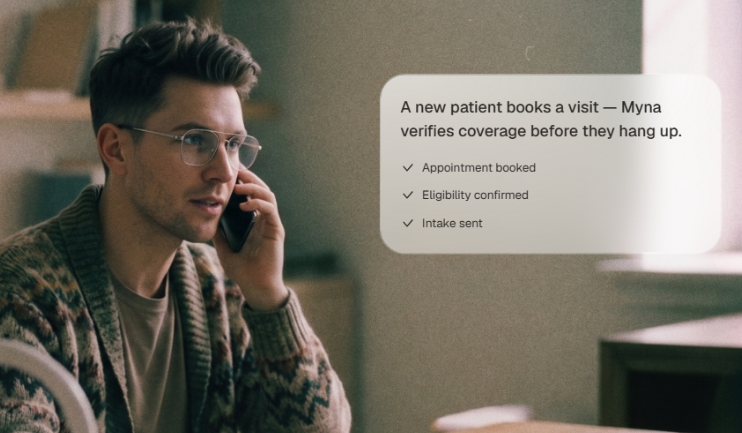
For example, a patient might call after hours to schedule an appointment. Myna can find the patient record, check appointment times, book the visit, verify eligibility, and send intake instructions. When staff returns the next morning, the visit is already booked and prepared instead of sitting in a voicemail queue.
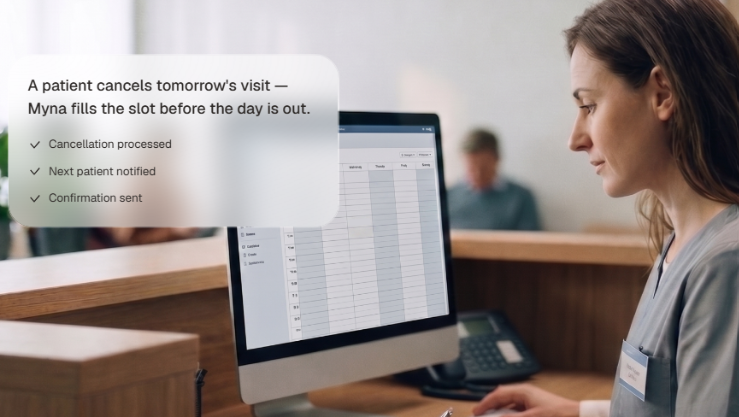
The same coordination can support other front-office workflows. If a patient cancels the appointment, Myna’s Waitlist Agent can identify eligible patients, reach out about the newly available time, and book the first patient who accepts, helping the location refill the slot without staff manually working through a call list.
For insurance workflows, Myna’s Insurance Verification Agent can verify eligibility and benefits before the visit and flag issues that require attention. If coverage cannot be verified or an insurance-related exception needs follow-up, it can route the case with the relevant patient and coverage context so staff can address it without starting from scratch.
Myna also supports controlled autonomy. Healthcare organizations can define autonomous or staff-in-the-loop workflows, configure processes by practice or location, and route clinical or out-of-scope requests to the appropriate human team instead of having the agent answer them directly.
FAQs
How to keep your front office working around the clock
Patients do not stop calling when the front desk closes. An unanswered scheduling request, incomplete intake form, or last-minute cancellation can quickly turn into more work for staff the next morning.
Myna’s healthcare AI agents keep those workflows moving. They can answer patient calls and chats 24/7, book and reschedule appointments in the EHR, verify insurance eligibility, complete pre-visit intake, send reminders, and help fill waitlist openings.
The result is a front office that can handle more patient demand without leaving every routine task for staff to pick up later.
See the AI agents Myna runs for healthcare and learn how Myna can keep front-office work moving across every location, at every hour.
About the Author
Somya is a Content Editor at Birdeye with 9+ years of experience in content management, primarily supporting B2B SaaS brands. She brings a strong command of content strategy, SEO, GEO, and editorial planning, along with a sharp eye for crafting narratives that engage and convert. Over the years, Somya has helped scale content operations, optimize digital presence, and drive organic growth & AI visibility for fast-paced tech companies. When she’s not writing or immersed in editorial calendars, you can find her playing with her dog, Kaizer. Connect with Somya Yesodharan on LinkedIn.