
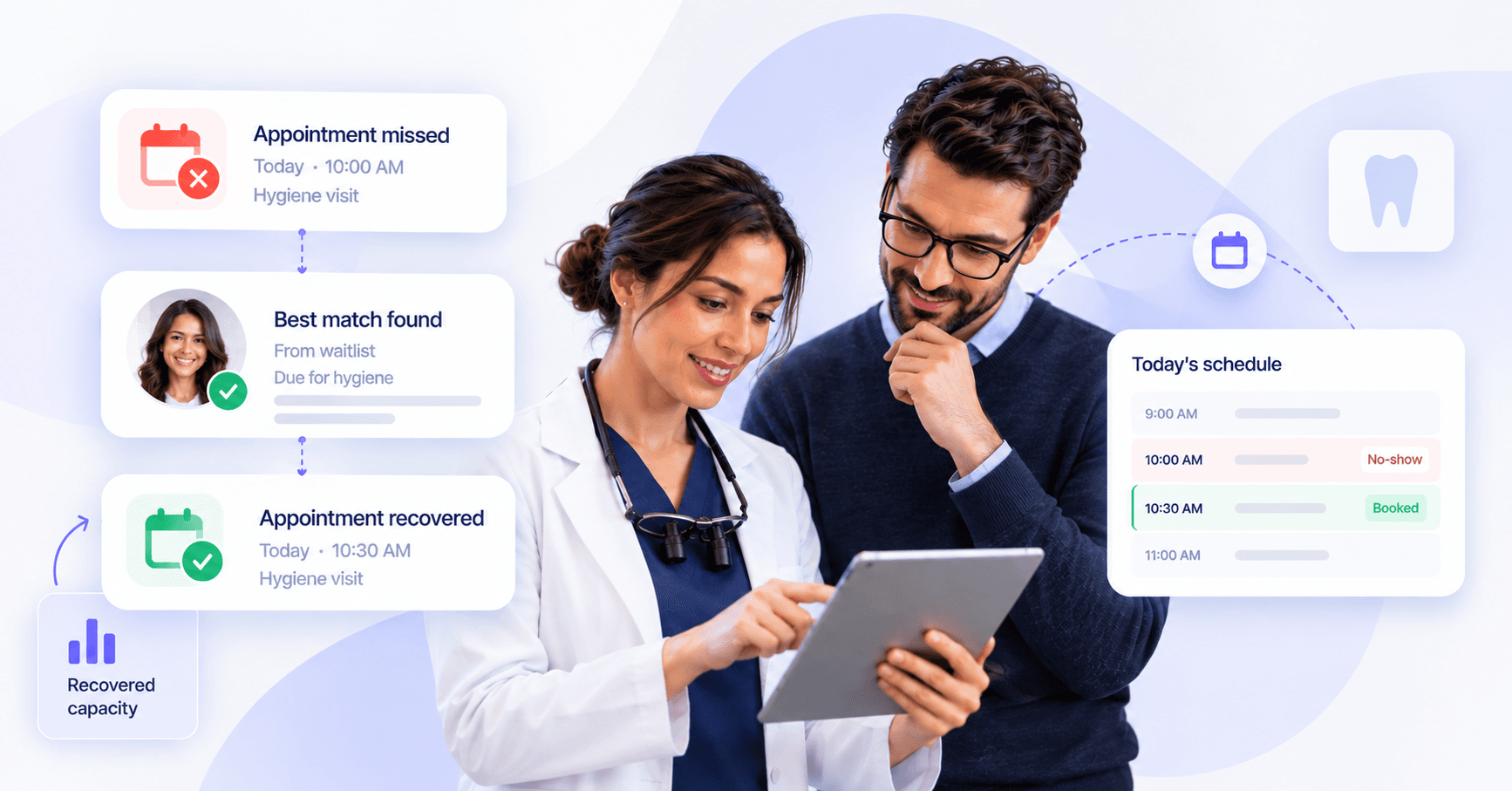
A no-show costs more than one appointment. It leaves a chair, provider time, and clinical capacity unused.
A survey from the American Dental Association Health Policy Institute found that 81.3% of dentists cited no-shows and cancellations within 24 hours as a barrier to full schedules. Another 42% cited cancellations made more than 24 hours in advance.
Dental DSO no-show recovery automation helps practices recover missed appointment capacity without relying on manual follow-up. It connects available slots with appropriate patients, outreach, and rescheduling workflows.
For one practice, recovering that opening is difficult enough. For a DSO, the same recovery problem repeats across every location.
Keep reading to see how DSOs can automate no-show recovery while connecting waitlist and recall workflows.
Why do no-shows create a bigger problem for DSOs?
Manual no-show recovery follows the same sequence every time: identify the opening, check the waitlist, contact a suitable patient, and update the schedule after they respond. The process depends on someone having time to start it. That dependency becomes harder across a DSO.
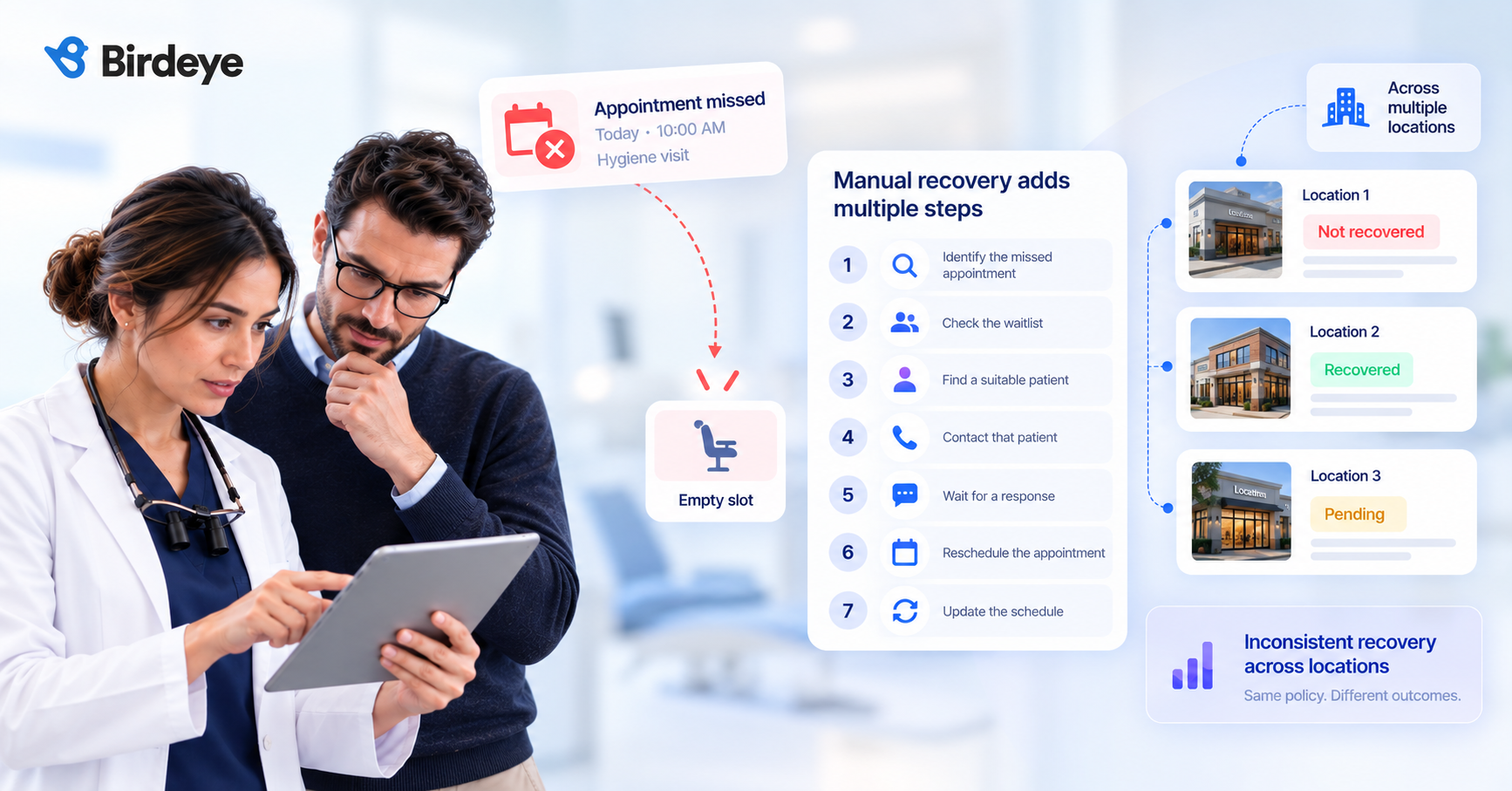
One location might refill an opening within an hour. Another might not notice it until the next morning. Staffing levels, appointment volume, provider schedules, and local processes all affect recovery speed.
The front desk also has competing priorities. When an opening becomes available, staff may check in patients, answer calls, handle scheduling requests, or verify insurance.
Teams know how to recover appointments. The challenge is finding the time to do it consistently.
What does research say about dental no-shows and appointment recovery?
Recent dental research points to several factors associated with missed appointments, including booking lead time, missed confirmation responses, and prior no-show history. A 2026 systematic review of machine-learning studies identified these factors as important predictors of dental no-shows.
A separate 2026 study across 127 U.S. health systems found a 25% median fill rate for appointments offered through automated waitlists. Among the 10 highest-performing systems, the rate reached 38.8%. The study also found that integration with broader scheduling infrastructure influenced results.
For DSOs, the practical takeaway is simple: recovery works best when available capacity, patient matching, outreach, and scheduling are connected.
How does dental DSO no-show recovery automation work?
Dental DSO no-show recovery automation connects a missed appointment with the next appropriate action. This can include identifying available capacity, finding a suitable waitlist patient, sending timely dental marketing messages, and supporting the rescheduling process.
A patient waiting for a hygiene appointment may not fit every opening. Provider, location, appointment type, timing, and scheduling rules can all matter.
That makes matching important. The system needs enough context to identify the right opportunity before contacting the patient.
It also needs a clear path for exceptions. Routine recovery can follow defined workflows. Cases requiring judgment should reach staff with the relevant context.
How should no-show recovery connect with patient recall automation?
No-show recovery and patient recall automation address different problems, but they can operate on a shared patient context. A missed appointment may require immediate rescheduling, while a patient who is due for preventive care may need recall outreach.
That creates two related workflows:
Recover the open appointment. Find an appropriate patient to fill the available capacity.
Continue patient follow-up. Prevent a missed appointment from ending the patient relationship when a recall is appropriate.
The workflows should not treat every no-show the same way. A patient may need immediate rescheduling, recall outreach, or both at different points.
That distinction keeps recovery focused while giving DSOs a way to connect today’s scheduling problem with broader dental patient retention strategies.
How does Myna automate no-show recovery for DSOs?
Myna, Birdeye's Operations AI Coworker, provides dental DSOs with six coordinated AI agents that work from a single patient record. Each agent handles a different front-office workflow, so no-show recovery can connect with scheduling, reminders, recall, treatment plans, and revenue workflows.
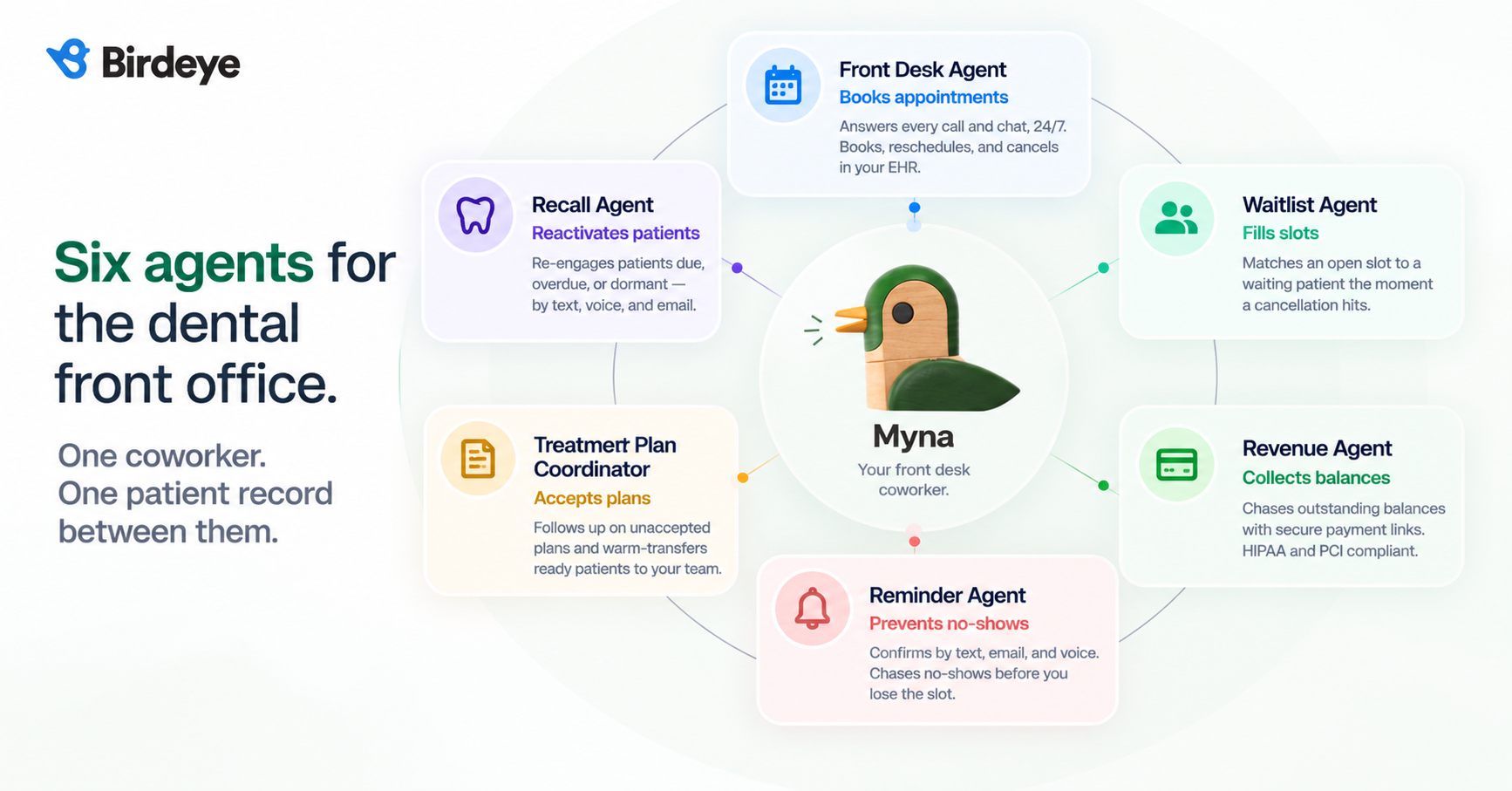
The six agents work across the dental front office:
- Recall Agent: Re-engages patients who are due, overdue, or dormant through text, voice, and email.
- Treatment Plan Coordinator: Follows up on unaccepted treatment plans and warm-transfers ready patients to the team.
- Revenue Agent: Follows up on outstanding balances with secure payment links.
- Front Desk Agent: Uses conversational AI in healthcare to answer calls and chats 24/7, and books, reschedules, and cancels appointments in the EHR.
- Waitlist Agent: Matches open appointment slots with waiting patients when cancellations create availability.
- Reminder Agent: Confirms appointments via text, email, and voice, and follows up before no-shows reduce capacity.
For no-show recovery, the most relevant agents work together: The Reminder Agent helps prevent missed appointments. The Waitlist Agent helps recover newly available capacity. The Front Desk Agent handles the resulting scheduling action. The Recall Agent supports longer-term patient follow-up when appropriate.
The other agents extend that same front-office coverage beyond appointment recovery. Treatment plan follow-up and outstanding-balance outreach can continue without creating additional manual queues for staff.
For DSOs, the advantage is coordination. Six agents share a single patient record, so each workflow can build on the context created by the others.
Staff still handle situations that require judgment. Myna handles recurring front-office work through defined workflows, helping DSOs apply a consistent operating process across locations.
How should DSOs measure no-show recovery automation?
No-show rate is only one metric. DSOs should also measure how effectively each location recovers capacity from missed appointments.
| Metric | What it shows |
| No-show rate | Frequency of missed appointments |
| Waitlist match rate | Frequency of openings matched to suitable patients |
| Recovery rate | Frequency of missed appointments rescheduled |
| Time to refill | How quickly open capacity is recovered |
| Manual touches | Staff effort required for each recovery |
| Recovery by location | Where recovery performance varies |
Time to refill deserves particular attention. A slot recovered two hours after a no-show has more value than one recovered days later.
DSOs should also compare recovery by location, provider, and appointment type. That makes operational differences visible rather than hiding them within a network-wide average.
FAQs
What can DSOs gain from automated no-show recovery?
For DSOs, the real challenge is consistency. A recovery process that depends on staff noticing every opening will perform differently across locations. Automation gives each location the same underlying workflow for identifying opportunities, reaching patients, and rescheduling appointments.
Automation changes that equation, in the same way dental marketing automation does for inquiries and bookings. It gives DSOs a repeatable way to respond to missed appointments, recover available capacity, and keep patients moving back into care.
Myna, Birdeye's Operations AI Coworker, brings those workflows together across appointment scheduling, waitlist management, reminders, and recall. Its coordinated agents help DSOs recover available capacity while staff stay in control of exceptions.
See how Myna automates no-show recovery and recall workflows across your DSO's locations.
About the Author
Somya is a Content Editor at Birdeye with 9+ years of experience in content management, primarily supporting B2B SaaS brands. She brings a strong command of content strategy, SEO, GEO, and editorial planning, along with a sharp eye for crafting narratives that engage and convert. Over the years, Somya has helped scale content operations, optimize digital presence, and drive organic growth & AI visibility for fast-paced tech companies. When she’s not writing or immersed in editorial calendars, you can find her playing with her dog, Kaizer. Connect with Somya Yesodharan on LinkedIn.