
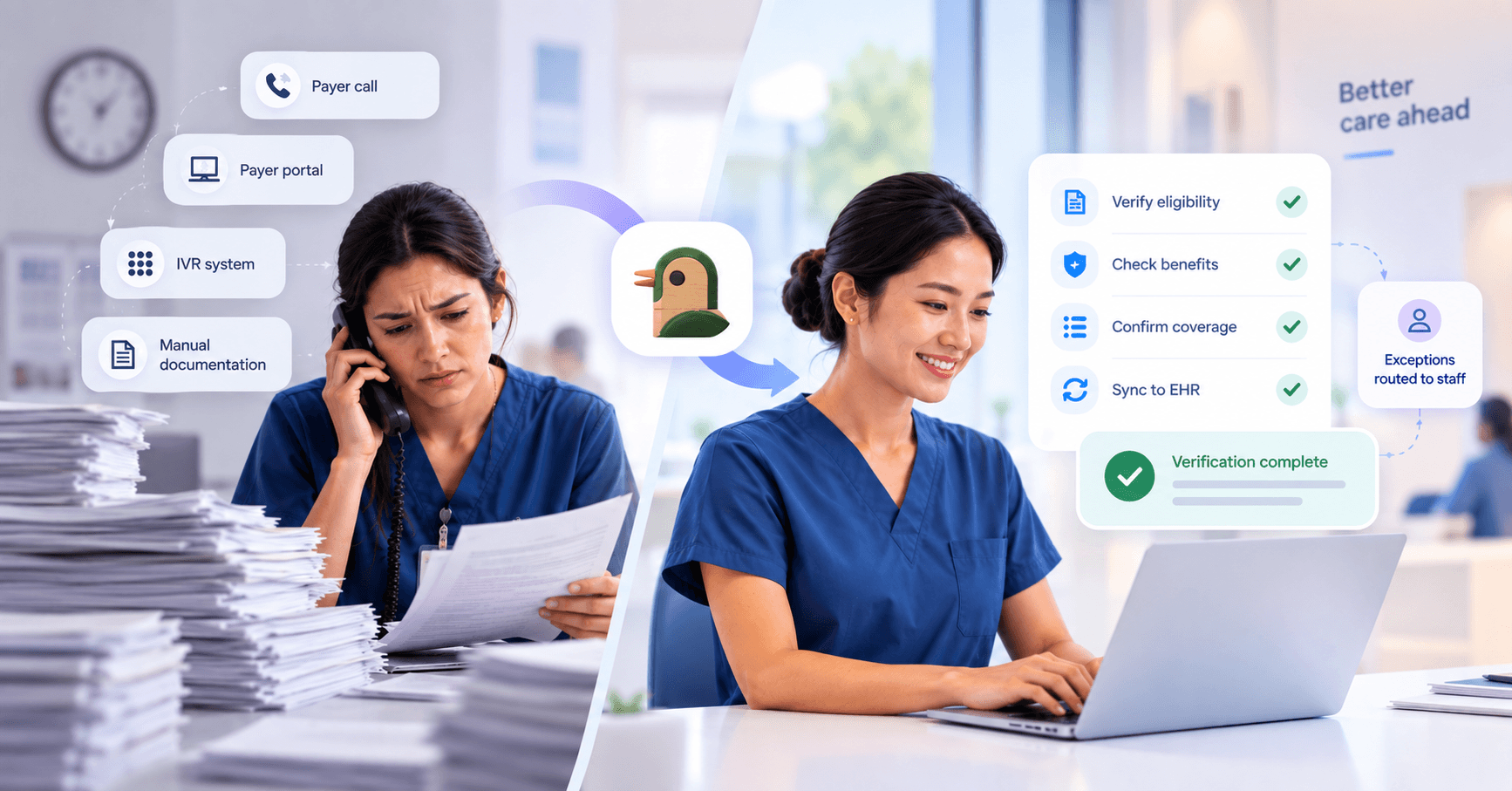
Understanding how to eliminate manual insurance verification matters because health system front desks can spend hours on it before patients arrive. The 2025 CAQH Index estimates $18.7 billion in remaining annual savings for medical organizations through greater administrative automation.
Staff review appointments, check coverage, follow up on missing information, and document results, one patient at a time. A single verification may take only minutes. Across a full schedule, those minutes add up quickly.
At one location, that workload can be easy to overlook. Across dozens or hundreds of locations, it becomes a recurring operational burden.
Keep reading to see where manual verification consumes staff time and how to eliminate manual insurance verification by automating the workflow.
What does manual insurance verification actually involve?
Manual insurance verification usually means confirming a patient's eligibility, benefits, and coverage details before care. Staff may review information already on file, access a payer portal, use an IVR system, or contact a payer when electronic information is insufficient.
The process can include checking:
- Patient and insurance information
- Eligibility for the planned date of service
- Coverage and benefit details
- Referral or authorization requirements, where applicable
- Information that needs clarification before the visit
- Verification results that must be documented for the organization
The operational problem is not simply time spent on payer calls. It is the manual work that remains when the verification workflow cannot be completed electronically.
Why does insurance verification take so much staff time?
Insurance verification takes time because staff must navigate different payer processes, resolve missing information, and document the outcome. A check may involve a portal lookup, an IVR system, or a call to the payer when electronic information does not answer the question.
The work also competes with everything happening at the front desk. A coordinator may start the morning reviewing upcoming appointments and checking coverage before patients arrive. Meanwhile, phones are ringing, patients need to be checked in, and same-day schedule changes need attention.
One payer may provide the needed information through a portal. Another may require an IVR lookup. A third may need direct follow-up because the information on file does not answer a specific coverage question. When details are incomplete or unclear, the verification takes another round of staff attention.
What does manual insurance verification cost health systems beyond time?
When coverage is not resolved before the visit, staff may need to address it during check-in. That can slow registration and pull attention away from patients already waiting, which affects customer service in healthcare.
The workload also competes with other front-desk responsibilities. Staff verifying coverage may need to answer calls, check in patients, handle registration, or manage schedule changes. Each interruption can leave verification work unfinished and create another task to pick up later.
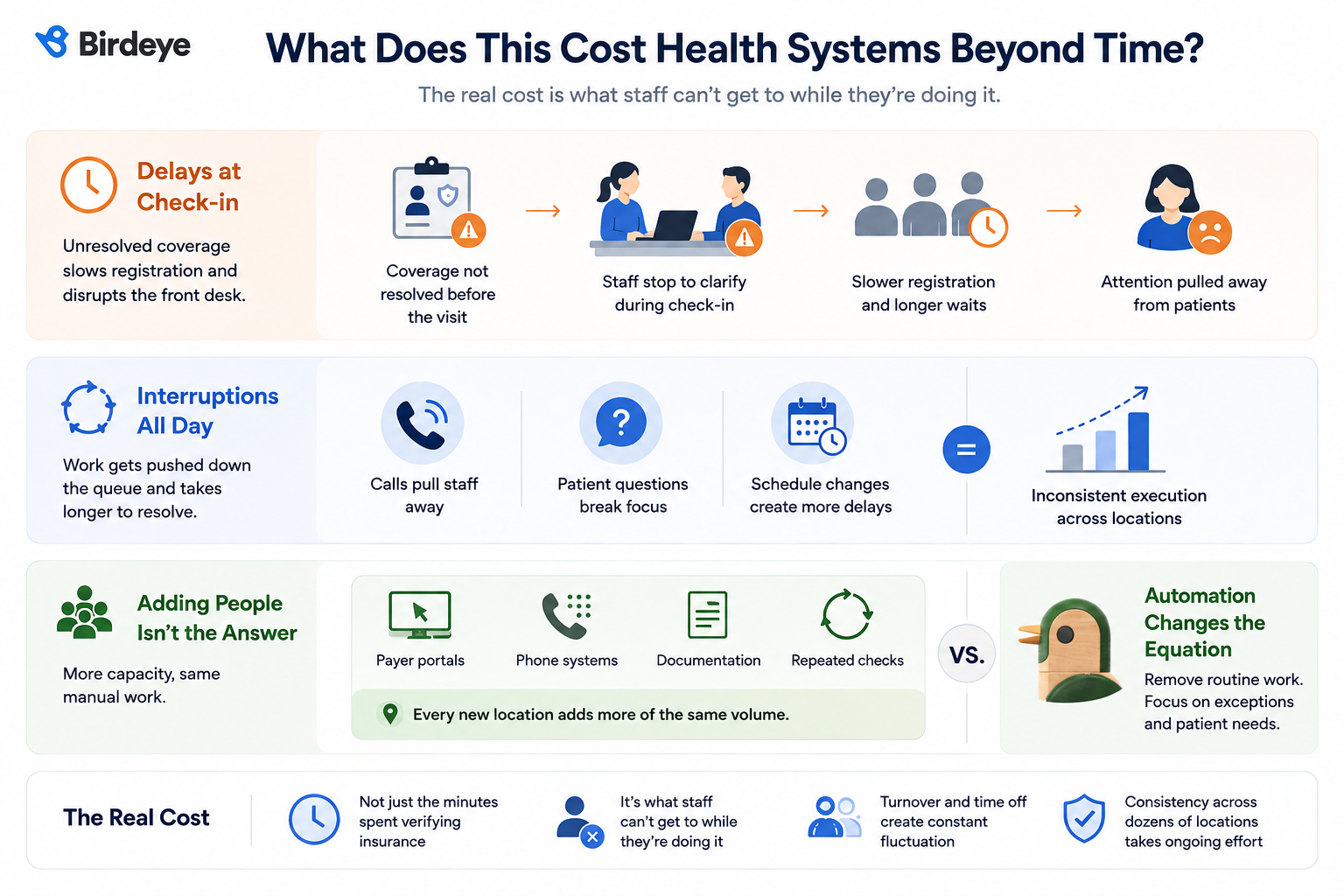
The impact also extends to staff workload. Routine verification requires consistent attention but often involves little judgment. Repeating those steps throughout the day can keep teams tied up in administrative work instead of patient-facing tasks.
The issue becomes more significant across multiple locations. Each site may have different staffing levels and different ways of handling unresolved coverage. Without a consistent process, some locations may complete verification before appointments, while others handle more of it during check-in.
How to eliminate manual insurance verification comes down to automation that removes that repetitive work rather than simply assigning it to more people.
Adding staff can absorb more volume, but it leaves the underlying workflow unchanged. Health systems still have to manage the same payer processes, documentation, and follow-up.
What should automated insurance verification actually handle?
For health systems working out how to eliminate manual insurance verification, effective automation should complete routine eligibility and benefits checks while providing staff with the context they need to handle exceptions. It should reduce repetitive work without removing human judgment from cases that need review.
A useful workflow connects verification to the patient's existing appointment and record. It uses relevant insurance information, returns verification results, documents the outcome, and routes exceptions to staff with the information they need.
| Manual workflow | Automated workflow |
| Review patient and insurance information | Use available patient and insurance context |
| Navigate the payer portal or IVR | Run the eligibility and benefits check |
| Review coverage information | Surface relevant verification results |
| Document the outcome | Connect results to the existing workflow |
| Investigate unclear cases manually | Flag exceptions for staff review |
| Repeat for each appointment | Continue across the scheduled workload |
The best automation also fits the systems staff already use, a standard test for patient engagement tools. Requiring another disconnected workflow simply shifts the administrative burden elsewhere.
How to eliminate manual insurance verification is a question of integrating verification into the appointment workflow, not of adding another task for staff to manage.
How does Myna automate insurance verification for health systems?
Myna, Birdeye's Operations AI Coworker, brings insurance verification into the front-office workflow. Its Insurance Verification Agent works with shared patient context and connects with EHR, PMS, and CRM systems. This approach makes healthcare front office automation part of the existing appointment workflow rather than another task for staff to manage.
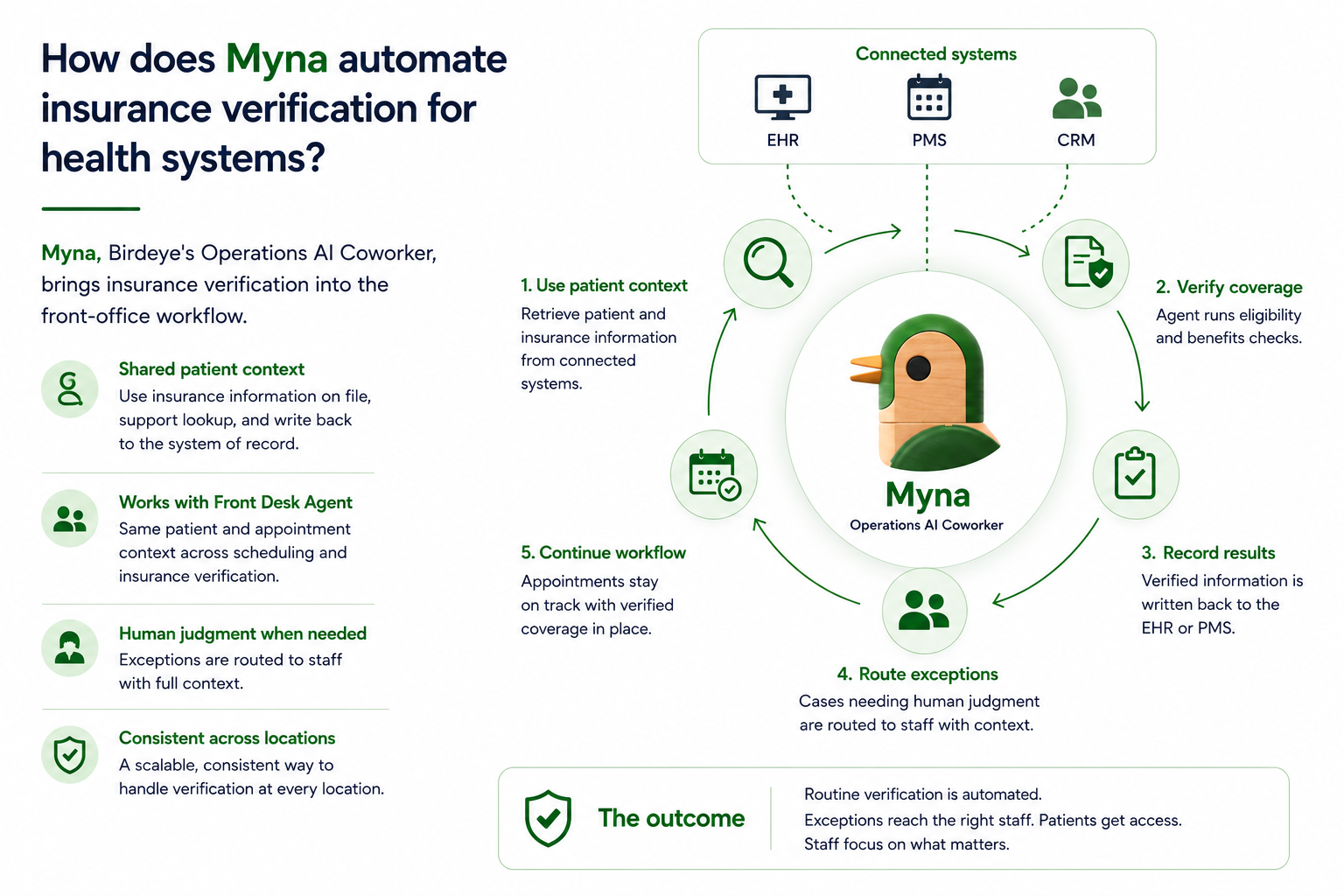
That shared context means the verification process can use information already associated with the patient. Myna can access insurance information on file, support patient lookup, and write completed actions back to the system of record.
The Insurance Verification Agent also works alongside the Front Desk Agent, which uses conversational AI in healthcare to handle patient calls and chats. Both workflows can use the same patient and appointment context, keeping insurance verification connected to scheduling and patient access.
When a case needs human judgment, Myna can route it to staff with the relevant context, following an AI human-in-the-loop model. Staff handle exceptions while routine verification moves through the defined workflow.
That gives health systems a consistent answer to how to eliminate manual insurance verification across locations, without requiring staff to repeat the same process for every appointment.
How to eliminate manual insurance verification across a health system?
The answer to how to eliminate manual insurance verification starts with the recurring workload it creates across every appointment and location. Automation removes routine steps from that workload, so staff can spend more time on patients and exceptions that require judgment.
For health systems, the larger opportunity is consistency. A standardized verification process can reduce variation across locations while giving teams more capacity for the work that cannot be automated.
Myna supports this operating model by connecting insurance verification with broader front-office workflows and existing healthcare systems, so verification follows the same consistent process at every location.
FAQs
How does Myna simplify insurance verification across multiple locations?
Insurance verification will always require accuracy. It does not always require a staff member to manage every routine step.
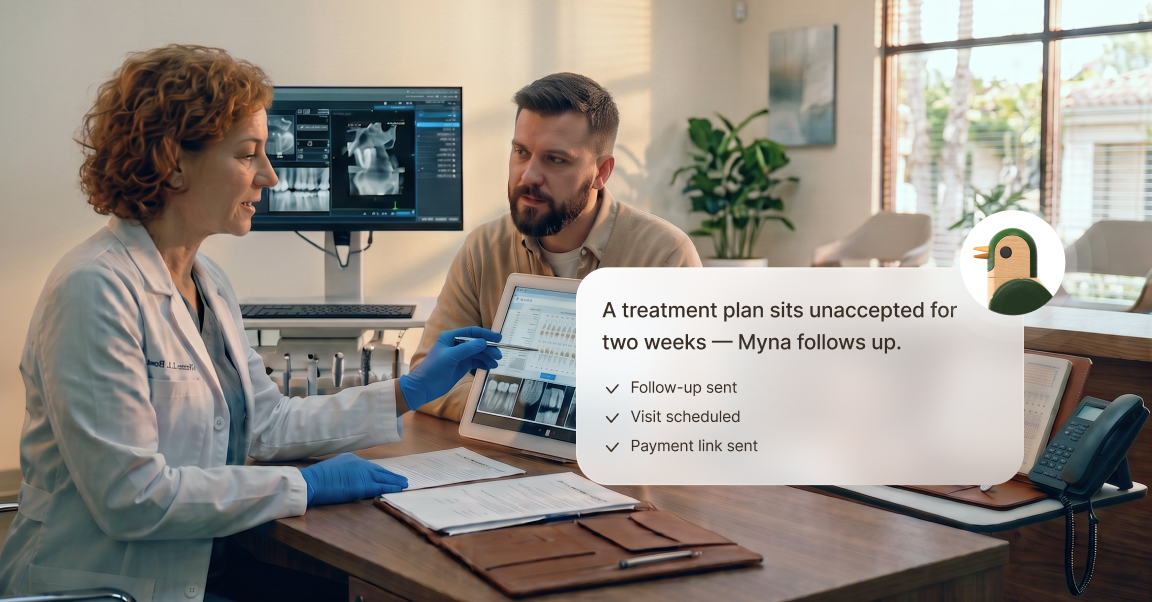
When routine checks move into the workflow, front-desk teams have more capacity to handle patients, scheduling issues, and exceptions that require human attention. Across a health system, this also creates a more consistent process from one location to the next.
That is the real opportunity: less administrative work competing with patient access, without adding another layer of staff to manage the same process.
Learn how Myna helps healthcare systems automate insurance verification while keeping staff in control of exceptions.
About the Author
Shruti Dugar is a Senior Content Marketing Writer with 11+ years of experience in content and storytelling. At Birdeye, she writes about how AI coworkers help multi-location brands win AI visibility and deliver seamless customer experiences. She’s also a published author & enjoys traveling. Connect with Shruti Dugar on LinkedIn.