
Healthcare phone lines carry everything from appointment requests and insurance questions to time-sensitive patient concerns, yet front-desk teams are already stretched managing patients in person. An AI voice agents for healthcare can take on routine inbound and outbound calls, understand what patients need, and complete tasks such as scheduling or rescheduling in real time.
Summary
Healthcare phone automation is shifting from simply answering or routing calls to actually resolving them. With the right integrations and guardrails, voice AI agents can turn routine conversations into completed front-office workflows while giving staff more capacity for patients and situations that need a human.
What is an AI voice agents for healthcare?
An AI voice agent for healthcare is a conversational system that can listen to a patient, understand what they are asking, respond in natural speech, and take approved actions during the call. It combines the following technologies to turn a spoken request into a completed task.
- Speech recognition
- Natural language processing
- Generative AI,
- Workflow automation
What healthcare calls can AI voice agents handle?
AI voice agents for healthcare can handle a wide range of patient access, revenue cycle management (RCM), and clinical outreach calls that require an immediate response or two-way conversation. Common use cases include:
- Appointment calls: Book, reschedule, or cancel visits in real time.
- After-hours calls: Handle routine patient requests when staff are unavailable.
- Prior authorization calls: Support routine prior authorization workflows by gathering information and following up on status.
- Eligibility and benefits calls: Verify insurance eligibility, check benefits, and collect coverage information.
- Waitlist calls: Offer open slots and confirm appointments.
- Recall calls: Re-engage overdue patients and help them book.
- Post-visit follow-ups: Check in with patients after appointments and collect responses based on approved workflows.
- Medication reminder calls: Remind patients about medications or other prescribed next steps using approved instructions.
- Treatment plan follow-ups: Answer questions and connect ready patients to staff.
- Payment and balance calls: Follow up on outstanding balances and guide patients to available payment options.
These use cases also reflect where phone work takes up staff time. In a MGMA poll of 294 medical practice leaders, 45% said eligibility and prior authorization consumed the most staff phone time, while 31% pointed to scheduling.
The value of voice is immediacy. Patients can ask questions, clarify details, and AI voice agents move the task forward.
How do AI voice agents for healthcare work during a call?
An AI voice call is a rapid loop of listening, interpreting, deciding, and responding. In a 2026 Mount Sinai study, an AI voice assistant deployed on an agentic AI framework made 1,606 pre-procedural calls to 1,431 patients. The first phase included 806 calls, while the second included 800 additional calls. In Phase II, 87.9% of calls reached the end of the scripted workflow, and patients were redirected to nurses when they needed human support.
While AI voice agents vary in how they are built and what workflows they support, a patient calling to reschedule an appointment moves through these steps:
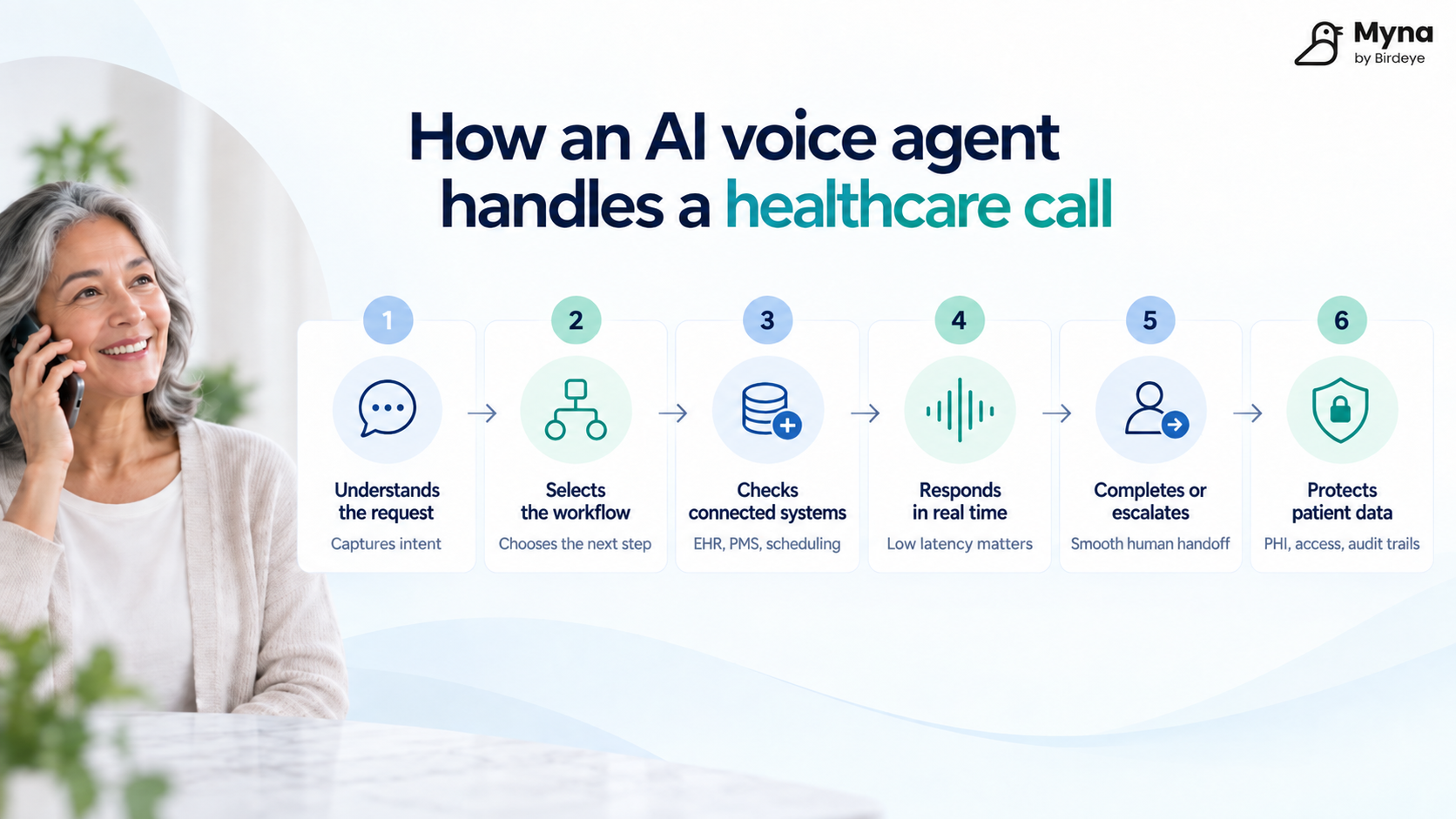
STEP 1: The agent understands the request: Speech recognition converts the caller’s words into text, while the system identifies details such as intent, appointment type, preferred date, and location.
STEP 2: It selects the right workflow: The request is matched to an approved process, and the agent determines what information it still needs from the patient.
STEP 3: The AI voice agent checks connected systems: The agent retrieves authorized information, such as available appointment slots, from the EHR, PMS, or scheduling system.
STEP 4: It responds in real time: The system converts its response back into speech while continuing to listen for questions, corrections, or interruptions. Latency, or the delay between the patient speaking and the agent responding, needs to stay low. Long pauses can make callers repeat themselves, talk over the response, or assume the call has dropped.
STEP 5: The agent completes or escalates the request: If the conversation stays within an approved administrative workflow, the agent can complete the task. If the patient mentions worsening symptoms or raises a question requiring clinical judgment, the call should move to the appropriate staff member. A strong handoff passes along the information already collected and the reason for escalation, so the patient does not have to start over.
STEP 6: It protects patient information throughout the call: Healthcare voice agents may handle names, appointment details, insurance information, and other protected health information (PHI). Security and compliance controls should therefore apply throughout the interaction, including patient authentication, role-based access, encryption, audit trails, data-retention policies, and applicable consent requirements for call recording.
How is an AI voice agent different from an IVR or answering service?
IVRs, answering services, and AI voice agents can all help manage incoming calls, but they differ in how they understand patients and what they can do after the call begins.
| Capability | Traditional IVR | Answering service | AI voice agent |
|---|---|---|---|
| How patients interact | Patients choose from fixed menu options | Patients speak with a human operator | Patients speak naturally and explain what they need |
| How requests are understood | Based on keypad or preset voice commands | Interpreted by the operator | AI identifies intent, context, and relevant details from the conversation |
| Scheduling capabilities | Usually routes callers to scheduling | May collect details for staff follow-up | Check availability, book, reschedule, or cancel when integrated with scheduling systems |
| EHR or PMS interaction | Typically limited | Usually limited unless the service has system access | Can read from and write back to connected EHR, PMS, or scheduling systems |
| After-hours coverage | Available, but often limited to routing or recorded information | Depends on staffing and service hours | Can handle approved workflows 24/7 |
| Human handoff | Transfers the call, often without much context | Operator can transfer or relay a message | Can escalate with the caller's context and information already collected |
For healthcare teams evaluating AI voice agents, the more useful measure is not simply whether it can answer the phone, but how much of the patient’s request it can safely resolve before a staff member needs to step in.
How does Myna use AI voice agents across the patient journey?
Myna is Birdeye’s Operations AI Coworker for healthcare and dental organizations. It answers calls 24/7 across every location and can book, reschedule, or cancel appointments directly in connected EHR and PMS systems.
Myna’s voice capabilities support several front-office workflows:
- Front Desk Agent: Answers inbound calls, understands what the patient needs, and books, reschedules, or cancels appointments in the EHR or PMS.
- Reminder Agent: Calls patients about upcoming appointments, answers questions, and helps resolve issues that could otherwise lead to a no-show.
- Recall Agent: Reaches out to due, overdue, or dormant patients by voice and can help them book their next visit during the conversation.
- Treatment Plan Coordinator Agent: Follows up with dental patients about unaccepted treatment plans and can connect patients who are ready to move forward with staff.
Myna is built on 13 years of intelligence, including context about the caller, the location, and the brand. That helps the AI voice agent follow each organization’s terminology, business rules, and approved workflows rather than treating every call the same.
FAQs
How can healthcare organizations turn every patient call into the right next action?
AI voice agents for healthcare are becoming practical front-office infrastructure because they connect conversation to action. What matters is not simply whether an AI sounds natural, but whether it can complete the right workflow, follow healthcare guardrails, update the system of record, and involve a human at the right moment.
For multi-location healthcare and dental organizations, the opportunity is even bigger. Every location can answer the phone consistently while helping local patients reach and act with the practice nearest them. Whether a patient calls to book, reschedule, verify insurance, or ask a routine question, AI voice agents can help each location respond in the moment without creating another staff queue.
Hear Myna take a call: Experience an AI voice agent handling a patient conversation in real time, from booking to rescheduling and common front-desk questions. Call Myna live.
About the Author
Somya is a Content Editor at Birdeye with 9+ years of experience in content management, primarily supporting B2B SaaS brands. She brings a strong command of content strategy, SEO, GEO, and editorial planning, along with a sharp eye for crafting narratives that engage and convert. Over the years, Somya has helped scale content operations, optimize digital presence, and drive organic growth & AI visibility for fast-paced tech companies. When she’s not writing or immersed in editorial calendars, you can find her playing with her dog, Kaizer. Connect with Somya Yesodharan on LinkedIn.