
The best AI agents for healthcare in 2026 include Myna, Assort Health, Hyro, and Luma Health, along with several other platforms that focus on operational workflows. These include patient access, appointment scheduling, intake, referrals, outreach, insurance verification, and front-office automation.
Summary
Healthcare AI agents are becoming more specialized, with some focused on front-desk operations, others on patient access, or medical scribing, diagnostics, and others on broader administrative workflows. This guide breaks down seven leading AI agents for healthcare and DSOs that automate patient-facing and administrative healthcare workflows, and what each platform is best suited for, so you can narrow down the options that fit your organization.
How did we select the best AI agents for healthcare?
The best AI agents for healthcare should do more than hold a natural conversation. They should complete real workflows, work reliably with your existing systems, and reduce repetitive work for staff.
To build this list, we evaluated healthcare AI agent platforms across six areas that matter most in real-world operations:
- Healthcare workflow depth: We looked at how many healthcare-specific workflows each platform can complete end to end, including scheduling, intake, referrals, insurance verification, reminders, payments, and patient outreach.
- EHR, PMS, or EMR integration: We assessed how deeply each platform connects with core healthcare systems, including whether it can access live data, update records, and write completed actions back to the system of record.
- Voice and digital capabilities: We compared support across phone, text, chat, and email, with additional weight given to platforms that can maintain context across channels.
- Human handoff and guardrails: We reviewed how each platform handles clinical, sensitive, or out-of-scope requests, including whether staff receive enough context to continue the interaction smoothly.
- Enterprise controls and security: We considered healthcare HIPAA compliance, permissions, workflow controls, auditability, and the ability to manage different rules across locations or teams.
- Operational impact: We looked for evidence that the platform can improve outcomes such as calls resolved, appointments booked, no-shows reduced, open slots filled, referrals converted, and staff capacity recovered.
We used these criteria to narrow the market to platforms that clearly offer healthcare-specific AI agents and can take meaningful action within healthcare workflows.
What are the 7 best AI agents for healthcare in 2026?
The 7 best AI agents for healthcare are as follows:
| Platform | Best suited for | Standout capabilities |
|---|---|---|
| Myna.ai | Enterprise healthcare and dental front-office operations | Calls, booking, reminders, waitlists, insurance verification, intake, recall, treatment-plan follow-up, balances, EHR/PMS execution |
| Assort Health | Patient access and specialty workflows | Scheduling, intake, referrals, eligibility, payments, medication refills, outreach |
| Hyro | Health system patient access and contact centers | Scheduling, prescription support, registration, physician search, routing, forms |
| Luma Health <br> | Patient access, scheduling, outreach, and operational AI <br> | Conversational AI, appointment scheduling and rescheduling, referral follow-up, care-gap outreach <br> |
| Notable <br> | Broad healthcare administrative automation <br> | Patient access, referrals, revenue cycle, prior authorization, care operations <br> |
| Avaamo | Digital front door and Epic-connected workflows | Scheduling, billing, medication, MyChart support, routing, after-hours support |
| Hippocratic AI | Patient-facing healthcare workflows | Scheduling, registration, insurance verification, prescription renewal, billing, care coordination |
Now, let’s look more closely at what each platform does, where it stands out, and how healthcare organizations can explore it further.
1. Myna
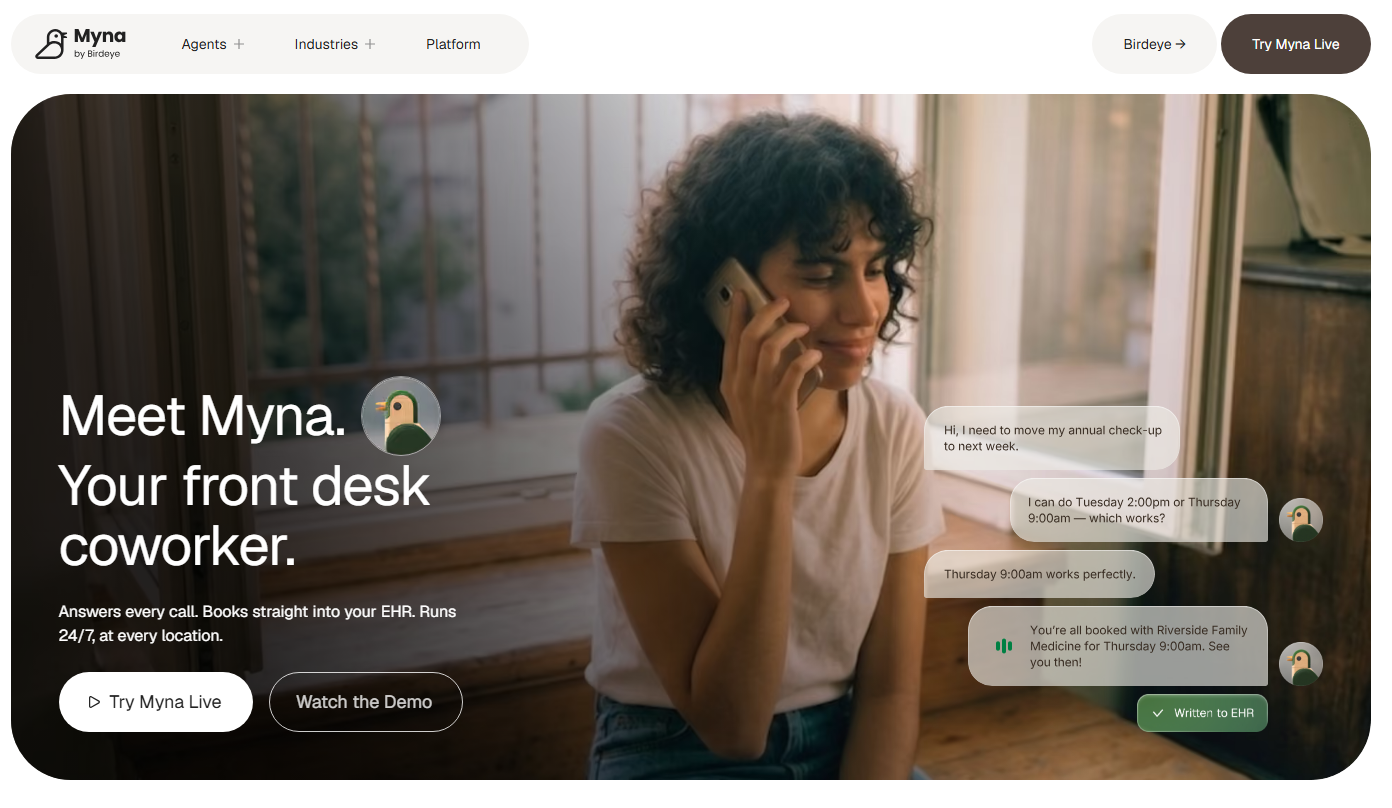
Myna is an Operations AI Coworker built specifically for enterprise healthcare and dental front-office operations. Instead of using separate bots for isolated tasks, Myna coordinates eight specialized AI agents that share patient, location, and workflow context.
Myna’s AI agents include:
- Front Desk Agent: Answers calls and chats 24/7 and handles appointment booking, rescheduling, and cancellations directly in the EHR or PMS.
- Reminder Agent: Confirms upcoming appointments across voice, text, and email and follows up with patients to reduce no-shows.
- Waitlist Agent: Identifies eligible patients when a slot becomes available and reaches out to refill the opening.
- Pre-Visit Agent: Helps patients complete required intake, forms, and pre-visit steps before their appointment.
- Insurance Verification Agent: Checks insurance eligibility and coverage information ahead of the visit, reducing manual verification work for staff.
- Recall Agent: Re-engages patients who are due, overdue, or dormant through voice, text, and email.
- Treatment Plan Coordinator Agent: Follows up with dental patients who leave without scheduling recommended treatment and helps move accepted treatment plans toward booking.
- Revenue Agent: Follows up on outstanding patient balances and guides patients toward payment without requiring staff to make repeated collection calls.
Key capabilities:
- 24/7 inbound voice and chat coverage
- Appointment booking, rescheduling, and cancellation
- Real-time EHR/PMS access and write-back
- Insurance eligibility verification
- Pre-visit intake
- Waitlist matching and open-slot filling
- Recall and dormant-patient reactivation
- Outstanding balance follow-up
- Location-specific workflows and controls
- Human handoff for clinical or out-of-scope requests
Where it stands out: Myna combines deep front-office automation with enterprise control, making it a strong fit for multi-location healthcare and dental organizations that need AI to take action across EHR and PMS workflows without losing local flexibility.
How does Myna support HIPAA compliance and safe AI workflows?
Myna is built for healthcare and dental environments where patient privacy, workflow control, and safe escalation matter. It supports HIPAA-compliant workflows and follows defined business rules. Enterprise healthcare and dental teams can also apply location-specific rules, permissions, provider availability, services, and workflow controls across their organization.
Myna supports enterprise healthcare and dental organizations, including Sutter Health, Aspen Dental, Smile Brands, etc helping teams automate front-office workflows across complex, multi-location operations.
How can you experience Myna?
You can call Myna directly and interact with the AI as a patient would, including booking or rescheduling an appointment or asking a front-desk question. Organizations can also request a personalized demo based on their workflows.
2. Assort Health
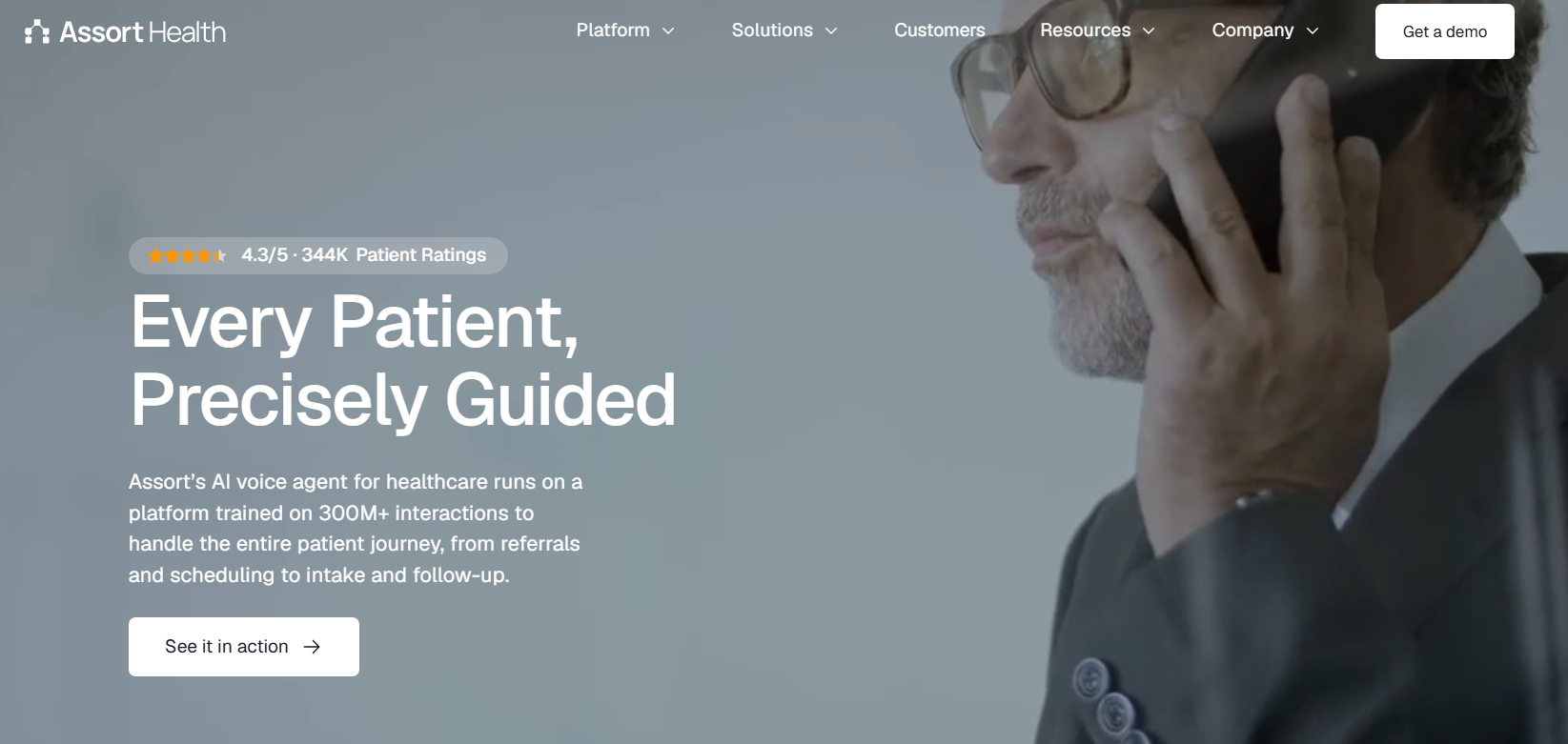
Assort Health offers healthcare AI agents focused on patient access and operational workflows. Its platform supports scheduling, intake, referrals, eligibility checks, payments, medication refill requests, waitlists, and proactive outreach. Assort is particularly focused on specialty healthcare, with agents designed to understand practice-specific scheduling rules and patient journeys while taking action inside connected EHR and PMS systems.
Key capabilities:
- 24/7 appointment scheduling and management
- Patient intake
- Referral management
- Insurance eligibility workflows
- Medication refill requests
- Waitlist management
- Proactive patient outreach
Where it stands out: Assort is a strong fit for specialty healthcare organizations that need AI to handle complex, practice-specific scheduling and patient-access workflows.
How can you explore Assort Health?
Healthcare organizations can request a personalized product walkthrough based on their specialty and patient-access workflows.
3. Hyro
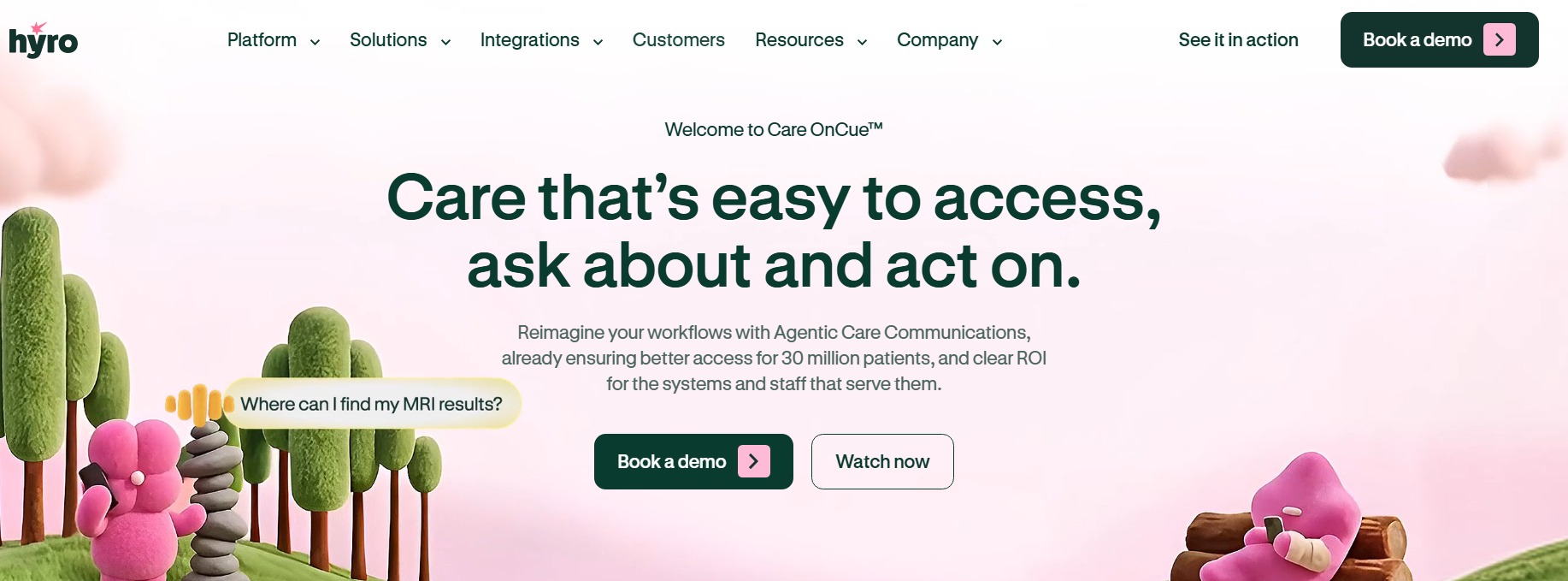
Hyro provides healthcare AI agents for patient access and contact center automation. Its voice and digital agents handle common patient requests such as appointment scheduling, prescription support, provider searches, registration questions, forms, FAQs, and routing. Hyro is designed for health systems that want to automate high-volume patient interactions while connecting those conversations to existing healthcare systems and escalation workflows.
Key capabilities:
- Voice and conversational AI
- Appointment scheduling and management
- Prescription support
- Patient verification
- Registration and forms support
- Intelligent call routing
- Human escalation
Where it stands out: Hyro is especially suited to large health systems and contact centers that need to automate high volumes of patient requests while maintaining routing and escalation paths.
How can you explore Hyro?
Healthcare organizations can review healthcare AI use cases and request a tailored platform walkthrough.
4. Luma Health
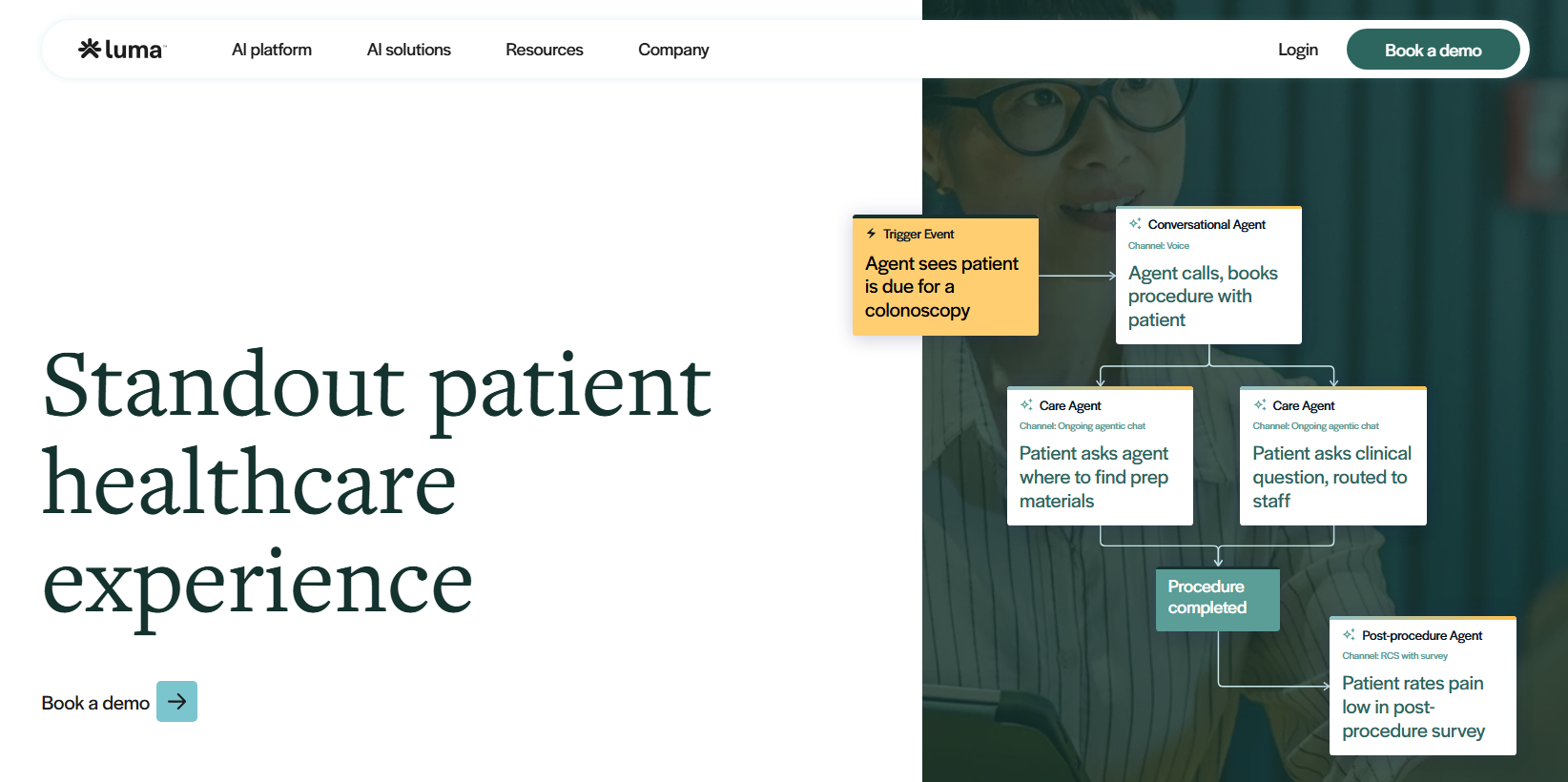
Luma Health provides operational AI for patient access, scheduling, outreach, and other healthcare workflows. Its conversational AI capabilities support both inbound and outbound patient interactions, helping organizations manage appointment changes, referrals, care-gap outreach, waitlists, and follow-up. Luma also connects communication with operational action, so a patient conversation can move into scheduling or another next step rather than ending with a simple response.
Key capabilities:
- Inbound and outbound conversational AI
- Appointment scheduling and rescheduling
- Cancellation and no-show recovery
- Referral follow-up
- Waitlist automation
- Patient intake and forms
- EHR-connected actions
Where it stands out: Luma combines inbound patient access with outbound engagement, making it useful for organizations focused on scheduling, referral follow-up, care gaps, and recovering missed or canceled appointments.
How can you explore Luma Health?
Organizations can request a platform walkthrough focused on their patient-access and operational workflows.
5. Notable
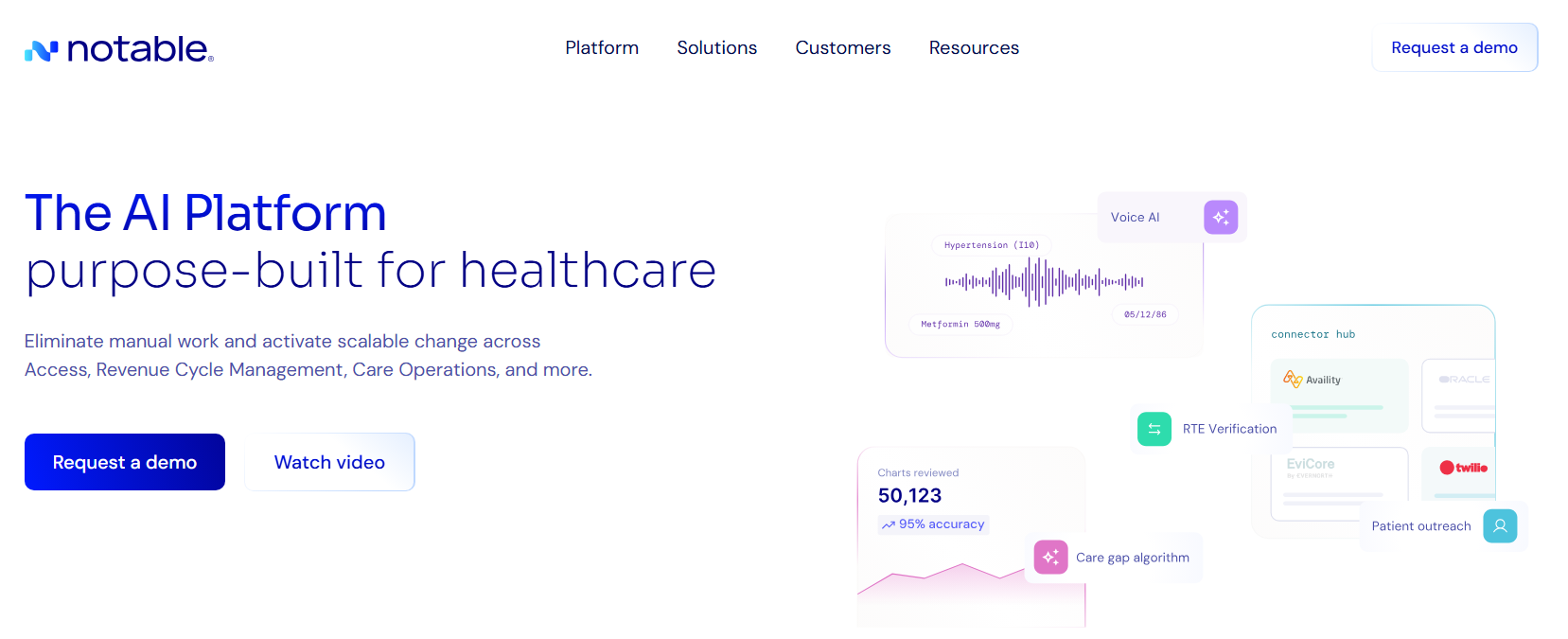
Notable is a healthcare AI platform that automates administrative workflows across patient access, revenue cycle management, and care operations. Its AI agents can support scheduling, registration, referrals, prior authorizations, collections, and care-gap outreach. Notable also gives healthcare organizations tools to build and customize workflows, making it suitable for teams looking to automate processes that extend beyond the front desk.
Key capabilities:
- Scheduling and registration
- Referral management
- Revenue cycle workflows
- Patient communication across channels
- Custom workflow automation
- Human review for complex processes
- Healthcare system integrations
Where it stands out: Notable reaches further into administrative and revenue-cycle workflows, making it better suited to organizations that want automation beyond patient access alone.
How can you explore Notable?
Healthcare organizations can request a walkthrough focused on the administrative workflows they want to automate.
6. Avaamo
Avaamo offers healthcare AI agents across patient access and digital front-door workflows. Its agents support appointment scheduling, billing questions, medication-related requests, MyChart support, patient routing, test results, and after-hours interactions.
Key capabilities:
- Appointment booking, cancellation, and rescheduling
- Billing and payment support
- Prescription refill workflows
- After-hours coverage
- Test-result workflows
- Voice and digital channels
- Epic-connected workflows
Where it stands out: Avaamo differentiates itself through a focus on digital front-door experiences and Epic-connected workflows, including MyChart support and after-hours patient interactions.
How can you explore Avaamo?
Healthcare organizations can request a platform walkthrough based on their patient-access and EHR workflows.
7. Hippocratic AI
Hippocratic AI develops generative AI agents exclusively for healthcare, with a strong focus on patient-facing and care-support workflows. Its agents can support scheduling, registration, referrals, care-gap outreach, post-discharge follow-up, medication-related interactions, billing questions, and chronic care programs.
Key capabilities:
- Appointment access and scheduling
- Pre-visit intake
- Referral management
- Insurance verification
- Medication support
- EHR-connected workflows
- Human escalation for clinical needs
Where it stands out: Hippocratic AI extends beyond front-office tasks into ongoing patient and care-support workflows such as post-discharge follow-up and chronic care communication.
How can you explore Hippocratic AI?
Healthcare organizations can request a tailored walkthrough of the AI agents relevant to their patient and care-support workflows.
Why should Myna be on your shortlist for healthcare front-office automation?
Front-office work rarely ends with one conversation. Booking can trigger insurance, intake, and reminder tasks, while a cancellation creates an empty slot.
Myna is designed around these connected workflows. It coordinates eight agents, so an event handled by one agent can trigger the next task. Healthcare organizations can automate booking, reminders, waitlists, insurance verification, and intake. Dental organizations can also extend automation into recall, treatment-plan follow-up, and balance collection.
Myna can follow location-specific hours, providers, services, and workflows while giving enterprise teams centralized controls. Staff stays involved for clinical questions, exceptions, and approvals.
The buying question therefore moves beyond whether AI can answer the phones to how much front-office work AI can complete without adding headcount.
FAQs
How to turn your front desk into a 24/7 operation?
Choosing among the best AI agents for healthcare starts with deciding what you want AI to own. The strongest fit is the platform that can complete your highest-volume workflows, work inside your existing systems, follow your rules, and free up staff capacity.
If front-office operations are your priority, compare the best AI front desk platforms by how much work they can take from call to completion.
Try Myna’s demo to see how Myna can answer patients 24/7, book directly into your EHR or PMS, and keep the next front-office workflow moving.
About the Author
Somya is a Content Editor at Birdeye with 9+ years of experience in content management, primarily supporting B2B SaaS brands. She brings a strong command of content strategy, SEO, GEO, and editorial planning, along with a sharp eye for crafting narratives that engage and convert. Over the years, Somya has helped scale content operations, optimize digital presence, and drive organic growth & AI visibility for fast-paced tech companies. When she’s not writing or immersed in editorial calendars, you can find her playing with her dog, Kaizer. Connect with Somya Yesodharan on LinkedIn.