

A medical answering service can cost from a few hundred dollars to several thousand dollars per month. The final price depends on call volume, coverage, billing model, and workflow complexity.
That pricing question is becoming more relevant as practices automate front-office work. A February 2026 MGMA poll found that scheduling was the top focus for AI automation at 31%. Calls followed at 27%, while registration and eligibility reached 23%.
So healthcare practices are comparing more than answering-service rates. They are also evaluating what AI in healthcare can handle and what staff still need to complete.
Keep reading to understand medical answering service pricing, monthly costs, and how Myna fits in.
How much does a medical answering service cost in 2026?
Medical answering service pricing varies by coverage, call volume, and billing model. Published 2026 pricing guides place basic services in the low hundreds, live-operator plans at around $800 to $1,200 per month, and higher-volume 24/7 services at $1,200 to $3,000 or more.
A useful starting range looks like this:
| Service model | Typical 2026 pricing | What affects the final cost |
| Basic after-hours coverage | ~$25 to $100+ per month | Call volume and included minutes |
| Per-minute live service | ~$1 to $3.50 per minute | Call length and billing increments |
| Per-call service | ~$1 to $2+ per call | What counts as a billable call |
| Live-operator service | ~$800 to $1,200 per month | Volume, coverage, and services included |
| 24/7 premium live coverage | ~$1,200 to $3,000+ per month | Volume, staffing, workflows, and locations |
| AI receptionist | Varies by provider | Usage, integrations, and workflow scope |
These published ranges vary because providers use different pricing structures and service levels. Aira's May 2026 guide, for example, puts medical-specialized live answering at roughly $300 to $1,500 monthly, while virtual medical receptionist services can range from $800 to $3,000+.
That variation makes the pricing model just as important as the advertised monthly rate.
What is medical answering service pricing per month?
Medical answering service pricing per month usually falls into three structures: usage-based plans, bundled monthly plans, or custom pricing for larger operations.
Per-minute plans charge for operator time. They can work for predictable, low-volume calls, but longer conversations increase the bill.
Per-call plans charge a set amount for each answered call. They make budgeting easier, but you need to understand how the provider defines a billable call.
Monthly bundles include a set number of minutes or calls. They provide more predictable costs until your practice exceeds the included volume.
For example, a service charging $1.25 per minute would cost $625 for 500 billable minutes. A 1,000-minute month would cost $1,250 before additional fees.
That calculation looks simple until billing rules come into play.
Some providers round call duration to billing increments. Others charge separately for overages, setup, holidays, bilingual coverage, or additional services. Published 2026 pricing guides specifically flag these fees as important parts of the final invoice.
So compare the expected monthly invoice, not just the advertised rate.
What factors affect the cost of a medical answering service?
The biggest pricing variables are call volume, average call length, coverage hours, and the amount of work required after a call is answered.
Consider these factors before requesting a quote:
- Call volume: More calls usually mean higher usage or a larger plan.
- Average call length: Longer conversations increase costs under per-minute pricing.
- Coverage hours: Nights and weekends cost less than full 24/7 coverage in some models.
- Appointment scheduling: Booking and changing appointments require more work than taking messages.
- System integration: EHR or scheduling can affect the scope and price.
- Languages: Multilingual coverage may affect pricing.
- Call transfers: Live transfers can require additional handling.
- Multiple locations: Enterprise organizations may need centralized management and location-specific workflows.
The last two factors matter most for healthcare practices with high call volume.
A service that only takes messages has a different cost structure than one that schedules appointments and integrates with practice systems.
That difference also changes what you should compare.
What does a medical answering service include?
A traditional medical answering service, including virtual receptionist call answering, typically provides call coverage, message taking, call routing, and escalation based on your instructions.
More advanced services may also support appointment scheduling, cancellations, rescheduling, patient questions, and other administrative requests.
The distinction is important because answering a call and completing the request are different workloads.
For example, a patient might call to move an appointment. A message-taking service can record the request for staff. A system connected to scheduling may be able to make the change during the same interaction.
The second model can reduce the work left in the staff queue.
That is why healthcare practices should ask what happens after the patient explains what they need. The answer can reveal more about the real operating cost than the monthly subscription.
How much does an AI receptionist cost compared with a medical answering service?
AI receptionist pricing uses many of the same models, including monthly subscriptions, usage-based pricing, and combinations of the two. The important difference is what the system can complete during the interaction, the same gap that separates agentic AI vs. AI-assisted tools.
A traditional answering service generally provides human coverage. An AI receptionist can handle conversations and complete defined administrative workflows when the technology supports those actions.
| What you're paying for | Medical answering service | AI receptionist |
| Call coverage | Usually included | Usually included |
| Routine patient questions | Depends on service | Depends on system |
| Appointment booking | May be available | Depends on integration |
| Rescheduling and cancellations | May be available | Depends on integration |
| EHR/PMS actions | Varies | Depends on platform |
| 24/7 availability | Available with some plans | Common capability |
| Usage-based pricing | Common | Common |
| Monthly subscription | Common | Common |
| Multi-location workflows | Depends on provider | Depends on platform |
There is no universal AI receptionist price. Published 2026 market guides show AI plans ranging from low monthly subscriptions to higher-priced plans tied to usage or practice size.
That makes a direct price comparison difficult.
Instead, calculate how much work each option completes. A lower monthly fee can look different when staff still need to schedule appointments, follow up with patients, or manage open slots.
That is where Myna enters the comparison.
How does Myna handle medical answering service work?
Myna, Birdeye's Operations AI Coworker, handles healthcare front-office workflows across calls and chats. It coordinates specialized agents around shared patient context, so the work can continue beyond the initial conversation.
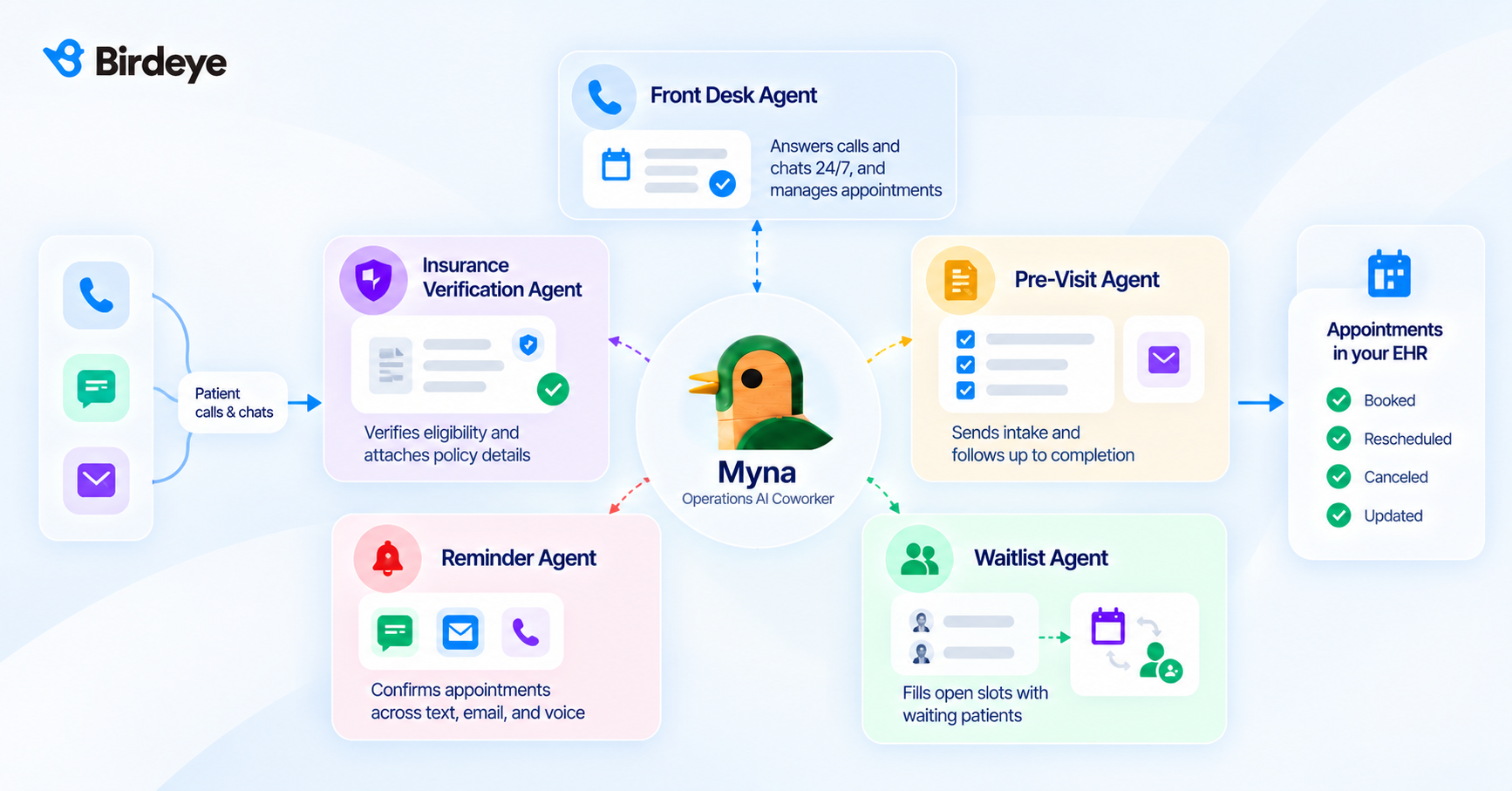
For healthcare practices, Myna coordinates five agents:
- Front Desk Agent: Answers calls and chats 24/7. Books, reschedules, and cancels appointments in the EHR.
- Insurance Verification Agent: Verifies eligibility in real time and attaches the policy to the appointment.
- Pre-Visit Agent: Sends intake before the visit and follows up until it is completed.
- Reminder Agent: Confirms appointments through HIPAA-compliant text messaging, email, and voice.
- Waitlist Agent: Matches open appointment slots with waiting patients when cancellations create availability.
These agents share patient context rather than operating as disconnected tools. That lets a patient interaction connect with the next front-office workflow instead of stopping at message capture.
Myna also keeps defined boundaries around healthcare automation. Myna is HIPAA-compliant and supports HIPAA-compliant handling of patient information in healthcare front-office workflows. Consent is captured on every call, while clinical questions route to the nurse line. Myna does not answer clinical questions. Healthcare practices can also choose autonomous or staff-in-the-loop workflows, a human-in-the-loop AI approach that keeps staff involved where judgment matters.
For enterprises, workflows can be configured by practice and location. Role-based access and enterprise SSO support centralized management across locations.
So when comparing medical answering service pricing with Myna, look beyond the cost of answering the call. Compare how much front-office work each option completes after the conversation begins.
See how Myna pricing works for healthcare practices.
What should healthcare organizations ask before choosing an answering service?
Healthcare organizations should ask how a quoted price translates into actual front-office coverage. The right questions expose costs that a rate card cannot show.
Ask these before signing:
- What exactly counts as a billable call or minute?
- What happens when the included volume is exceeded?
- Are scheduling and rescheduling included?
- Can the service work with our EHR and live appointment availability?
- What happens to requests that require staff judgment?
- Can the same workflows operate across multiple locations?
- Which services carry separate fees?
Then run your own numbers.
Take your average monthly call volume, average call duration, coverage hours, and required workflows. Use those figures to estimate the actual monthly cost.
That gives you a more useful comparison than choosing the lowest advertised rate.
FAQs
What should you look at beyond medical answering service cost?
Medical answering service pricing only tells part of the story. The more useful number is what your practice pays for the work that actually gets completed.
For healthcare groups, that can include answering calls, booking appointments, verifying insurance, completing intake, recovering canceled slots, and following up with patients.
Myna brings those workflows together through one Operations AI Coworker, while keeping staff involved when human judgment is required.
See how Myna can handle more of your healthcare front office.
About the Author
Shruti Dugar is a Senior Content Marketing Writer with 11+ years of experience in content and storytelling. At Birdeye, she writes about how AI coworkers help multi-location brands win AI visibility and deliver seamless customer experiences. She’s also a published author & enjoys traveling. Connect with Shruti Dugar on LinkedIn.